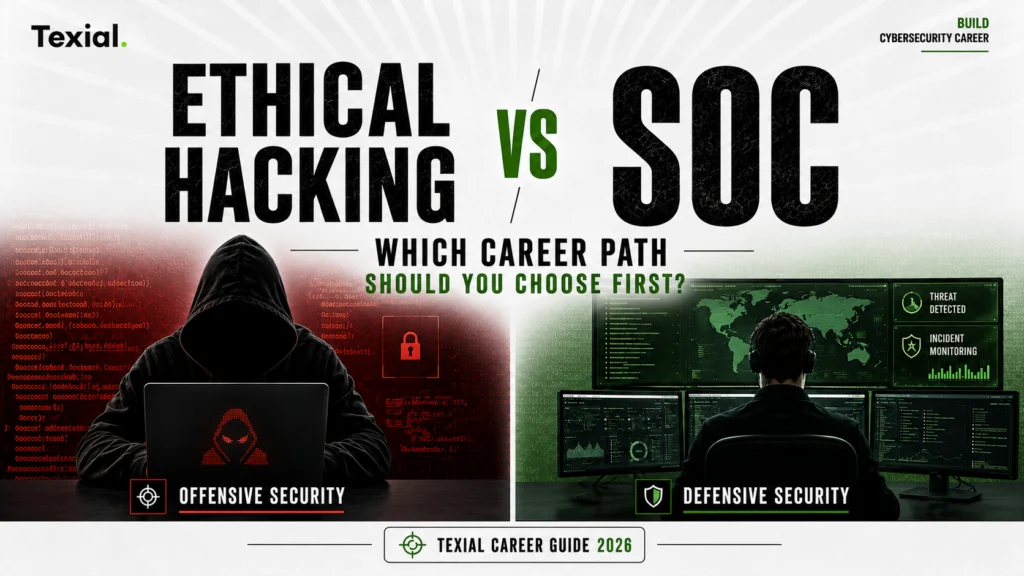
There’s a question that keeps showing up in cybersecurity groups, comment sections, and even random DMs from people just starting out: Ethical Hacking or SOC? Attack or defend? Which one do I start with?
The majority of the information available on the internet is not very helpful. Either they tell you to follow your passion, but that’s not any advice at all, or they drown you in so many technical terms that you tend to lose track of the question you had originally asked.
Let us cut to the chase and make things clear without any drama or movie-hacker clichés. Just the cold hard truth about these two careers in the year 2026 and how they suit your requirements.
The Reality of Ethical Hacking (The Attackers)
Ethical hacking is cybersecurity’s front line of offense. Stripped down to its absolute core, the job is simple: attack, exploit, and break in. The only difference between you and a cybercriminal is a signed contract, a strictly defined scope document, and a green light from the target.
People who thrive on this side of the fence possess a unique, restless kind of curiosity. They don’t just want to know how a system works; they want to know exactly how it fails before a malicious actor finds out first.
- Ethical Hacking: The foundational mindset. You learn to think, move, and breathe like an adversary so you can beat them to the punch.
- Penetration Testing: Hunting for the one door someone forgot to lock. You spend your days actively probing networks, web applications, and physical systems for security flaws.
- Vulnerability Assessment: The unsung hero of cybersecurity. It isn’t as flashy as a full exploit, but systematically mapping out an organization’s weaknesses provides massive, real-world value.
- Red Teaming: Full-scale, unannounced combat simulations. This goes beyond looking for software bugs; you are testing whether an organization’s human teams and security controls actually hold up under live, real-world pressure.
Forget the “hoodie-in-a-dark-room” stereotype; the reality of offensive security is much slower, well-documented, and methodical. In reality, hacking is not the Hollywood fast-paced hacking you see on television. It’s slow, methodical detective work with keyboards, and often it requires you to re-test the same vulnerability five different ways just to be 100 percent sure. If you have the discipline for this meticulous grind, it naturally paves the way for high-stakes careers as an ethical hacker, penetration tester, security consultant, or Red Team analyst where you are ultimately paid to find the fatal crack in a system before someone with bad intentions does.
SOC — The Defensive Side
If the offensive side is about breaking in, the Security Operations Center (SOC) is about one core mission: detect, respond, and protect. This is the digital frontline where you stand between the attackers and the company’s data.
The defensive side offers distinct paths focused on strengthening and maintaining security:
- SOC Analyst / Threat Monitoring: Your primary job is to continuously monitor threats and alerts. You are detecting and analyzing suspicious activities as they happen.
- Incident Responder: When an attack slips through, you are the one responding quickly to security incidents to minimize the impact.
- Security & Blue Team Analysts: These roles focus heavily on defending systems and strengthening security controls. You investigate threats and ensure the organization’s overall security posture remains rock solid.
- Mastering SIEM Tools: Defensive professionals spend their time working deeply with industry-leading SIEM (Security Information and Event Management) tools to track and manage everything happening on the network.
On the flip side, the defensive realm of a Security Operations Center (SOC) is far from just passively staring at a wall of monitors; it is a high-stakes, real-time investigative puzzle. You live in the logs, mastering SIEM tools to sift through massive amounts of data and piece together the forensic trail of an attack before it escalates. If you thrive on this intense, analytical detective work and the adrenaline of real-time threat detection, this path naturally builds into critical careers like SOC Analyst, Security Analyst, Incident Responder, or blue team analyst roles where you are the undisputed digital frontline, paid to spot the threat, shut the door, and protect the house.
Which One Actually Fits You
Ethical hacking is your lane if the thrill of breaking a system sounds genuinely fun, not just impressive. This is for the hands-on problem solvers who want to tear things apart rather than just read about them in a textbook. If your ultimate goal is to launch full-scale red team simulations and you don’t mind putting in the work to build a serious arsenal of exploits over time, this is where you belong.
The SOC, on the other hand, is your calling if you have a relentless eye for detail and notice what everyone else completely misses. There is a massive, highly satisfying adrenaline rush in chasing down live alerts, piecing together a complex incident, and slamming the door shut on a threat. If you want steady, iron-clad industry demand and a stable career trajectory rather than just a flashy title, the defensive frontline is waiting for you.
However, there is a secret that is well kept within the cybersecurity community: You do not need to limit yourself to just one.
The truth is that both sides will win individually. The most dangerous ethical hackers are the ones who have full understanding of the way the SOC works, and this is what allows them to outsmart all security measures. On the other hand, the most sophisticated and highest-paid SOC analysts are the ones who understand the mind of the hacker and can always predict his moves.
Why Limit Yourself to Just One?
To be the best at defense, you have to know the offense. To be the best at offense, you have to understand the defense. By training in both ethical hacking and SOC operations, you don’t just learn a job; you make yourself an unstoppable, highly sought-after force in the job market.
Don’t settle for half the skills. Master the attack, perfect the defense, and write your own ticket in the industry.
The Secret the Industry Doesn’t Tell You: Why Choose When You Can Master Both?
This is the part most career advice conveniently skips. The most valuable professionals in this field, the ones tech companies and enterprises actually fight over, aren’t purely offense or purely defense. They master both sides.
It makes perfect sense when you think about it: you cannot defend a network effectively if you don’t understand exactly how it gets broken into, and you cannot launch a lethal attack without knowing how real-world defenses are built.
That critical overlap is the exact reason we built a 3-month intensive program around two certifications side-by-side, rather than forcing you to make an impossible choice on day one. By combining TISA (Texial Information Security Auditor) for offensive security and TCSA for SOC operations, we merge ethical hacking and defensive strategy into a single, powerhouse learning track.
Here is what you actually walk away with:
- Offensive Security Skills (TISA): The complete ethical hacking toolkit to break systems, expose vulnerabilities, and think like a genuine adversary.
- Defensive Security Skills (TCSA): Deep-dive SOC operations, where you learn to monitor alerts, dissect logs, and shut down live attacks.
- A Unified Architecture: You get everything in one cohesive structure, rather than suffering through two completely separate learning paths that most people never find the time to combine later.
We don’t do massive theory dumps and call it a day. The format leans heavily into hands-on labs in realistic environments, giving you actual, practical projects that will turn heads in an interview. Plus, we back the technical training up with aggressive job-hunting support—from resume building to interview prep—ensuring you are fully prepared to land the role.
If you are still torn between Ethical Hacking and SOC after reading this, that isn’t indecision. That is just your gut telling you not to lock yourself into a single identity too early. The most well-rounded, highest-paid security professionals out there tend to be the ones who never fully committed to just one side.
Common Questions
Is Ethical Hacking harder than SOC?
Not harder—just wired differently. Ethical hacking gets technical fast, focusing heavily on exploit mechanics, finding bypasses, and thinking creatively. A SOC role leans more on sharp pattern recognition, alert triage, and investigative process. Neither is inherently superior; it comes down to what kind of puzzle your brain naturally prefers solving.
Which path pays better?
In the long run, salary depends far more on your experience, specialized certifications, and overall expertise than the path you started with. Senior penetration testers can command massive premiums, but a highly skilled SOC incident responder or threat hunter is just as valuable to an enterprise. The real secret to a higher salary? Being the professional who understands both sides.
Can a total beginner start in a SOC?
Absolutely. In fact, it happens all the time because monitoring traffic and managing alert triage feels much more approachable early on for a lot of people. However, here is the catch: you will be a vastly more effective defender from day one if you already know basic offensive concepts, because you’ll actually understand exactly what you are defending against.
Do companies expect both skill sets now?
For standard, baseline entry-level roles? Not always. But if you want to stand out from hundreds of applicants, it is becoming the ultimate differentiator. Modern security teams are consolidating, and the professionals who are fluent in both offense and defense are the ones who skip the long entry-level line and move up the ladder fast.
Ready to dominate both sides of the game?
Stop trying to pick an identity before you’ve even entered the field. Master the attack with TISA and perfect the defense with TCSA in one comprehensive, hands-on 3-month program.
Conclusion
Ethical hacking is the offense while the SOC is the defense. However, what is true about the contemporary cybersecurity industry is that it is on the hunt for people who don’t limit themselves only to one aspect.
The difference between knowing “how exactly this system fails” and “how exactly you can prevent it from failing” is much narrower than it might appear at first sight. The point here is to close the gap because if you are willing to become an influential player in this market, there is nothing more valuable that you could do.