To Defend a System, You Need to Know How to Break It. TCPT Teaches You Both.
Here’s a question worth sitting with: how does a company know its security is actually working?
Vendor promises don’t answer it. Compliance checklists don’t answer it. The only real answer is to have a skilled, ethical professional attempt to break through the defenses — deliberately, systematically, and thoroughly — and then report back exactly what they found.
That professional is a penetration tester. And the Texial Certified Penetration Tester (TCPT) program is built to create them.
The Mindset Shift That Changes Everything
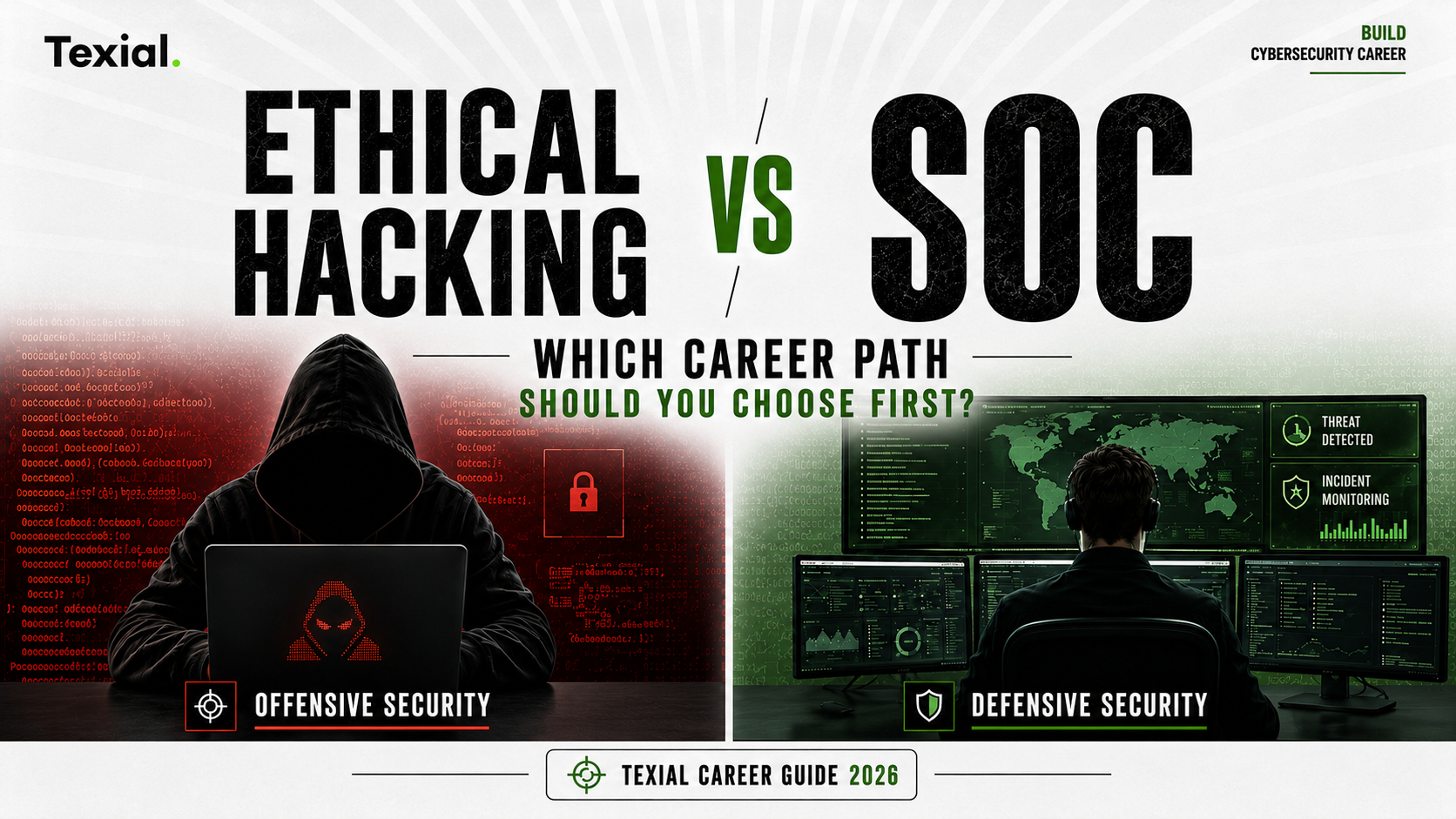
Most security training starts from a defensive position. You learn what to protect and how to protect it. Penetration testing flips this completely.
The question isn’t “Is our firewall on?” It’s “If I were an attacker, how would I get past it?”
This shift in perspective is uncomfortable at first — but it’s also what makes penetration testers so valuable. They find the gaps that automated scanners miss, the misconfigurations that pass compliance audits, the trust relationships between systems that can be leveraged into full network compromise. You can’t find those things by playing defense. You have to learn to think like the threat.
TCPT gives you the technical skills and the adversarial mindset to do exactly that.
What TCPT Trains You to Do
Strategic Reconnaissance (OSINT & Scanning): Before any attack begins, there’s research. You’ll learn to map an organization’s external footprint — domains, IP ranges, exposed services, leaked credentials, employee information — all gathered through open sources, without touching a single system.
Manual Vulnerability Research: Automated scanners produce lists. Experienced testers know which items on those lists actually matter, how to chain them together into something meaningful, and how to find the vulnerabilities that the tools miss entirely.
Exploitation & Post-Compromise Techniques: You’ll work through the OWASP Top 10 for web applications, practice exploiting common network misconfigurations, and develop the hands-on skills to escalate privileges from a limited foothold to full system control.
Active Directory Attacks: Most corporate environments run on Active Directory. Understanding how to enumerate it, move laterally through it, and escalate within it is one of the most sought-after skills in offensive security today.
Wireless & Mobile Security Testing: The attack surface doesn’t stop at the network perimeter. TCPT covers Wi-Fi protocol weaknesses and mobile application vulnerabilities — both increasingly common areas of testing engagement.
Social Engineering & Physical Security: Technical defenses are only as strong as the people and policies behind them. You’ll learn to evaluate the human element — how attackers use it, and how organizations can harden against it.
Post-Exploitation & Persistence Analysis: What happens after an attacker gets in? How do they maintain access, cover their tracks, and move toward their objective? Understanding this is critical both for attack simulation and for helping organizations detect and eradicate persistent threats.
The Career Paths That TCPT Opens
Penetration Tester (Network / Web / Mobile): The core role — contracted to find vulnerabilities across an organization’s infrastructure and document them clearly so they can be fixed.
Ethical Hacker: Similar to penetration testing but often broader in scope. Many ethical hackers work across multiple clients as independent consultants.
Red Team Operator: An advanced role involving extended, sophisticated attack simulations designed to test not just individual vulnerabilities but an organization’s overall ability to detect and respond to a skilled adversary.
Vulnerability Researcher: A more research-focused path, hunting for previously unknown flaws — zero-days — in widely-used software and hardware.
Exploit Developer: A highly technical niche focused on building the actual tools and scripts used to demonstrate and exploit specific vulnerabilities.
Security Consultant: Applying offensive expertise in an advisory capacity — helping organizations understand their risk landscape and build more effective defenses.
The Market for Offensive Security Professionals
Regulatory requirements and cyber insurance mandates are fundamentally changing how organizations approach security testing. It’s no longer enough to have controls in place — organizations must demonstrate, through actual testing, that those controls work.
This has created a specific and growing demand for certified professionals who can perform credible penetration tests and produce documentation that satisfies both internal leadership and external auditors. The TCPT credential signals exactly that capability.
Meanwhile, AI-driven attack tools are raising the stakes on both sides of the equation. Organizations facing more sophisticated threats need more sophisticated testers. The demand is real, it’s growing, and it’s not going away.
Is TCPT Right for You?
Graduates entering cybersecurity: If you want to skip the long road through general IT and step directly into a specialized, high-value offensive security role, TCPT is the most direct path.
SOC analysts and blue team professionals: Understanding how attackers operate makes you dramatically better at detection and response. TCPT gives you that perspective — and opens entirely new career directions.
Network and systems specialists: You already know how infrastructure is built. Now learn how it’s broken — and how to make it unbreakable.
Career changers: You don’t need years of coding experience. You need analytical thinking, a genuine curiosity about how systems work, and the willingness to put in the hours in our lab environment. We’ll give you the rest.
Think Like an Attacker. Build a Career Defending the World.
The organizations most vulnerable to cyberattacks are the ones that have never tested their defenses from the outside. Penetration testers are the professionals who change that.
If you’re ready to build the skills that put you on the front lines of offensive security, the TCPT program is where you start.