Cyber Security Course in Pune
Join our course in Pune and learn how to protect the digital world in this course. You’ll learn about ethical hacking, network and data security, risk management, and even how to secure things in the cloud. You’ll also work on real projects and learn from people in the field.
Our Cyber Security Course in Pune gets you up to speed with what you should know and do in this popular field. Cyber security experts will help you in labs, and our course follows the rules for global benchmark.
Sign up now and learn the skills to become a cyber security analyst, penetration tester, and security specialist.
- Who We Are?
Texial Cyber Security
Get certified by Pune's best cyber security pros experts
We want to give you the top cyber security course in Pune so you can do well in this job. We’ll teach you the stuff and let you practice on real projects. Our course makes sure you get training that meets global rules. You’ll get this through labs, advice from experts, and a course that goes with top papers. Our goal is to give each student the knowledge, skills, and confidence to do well in the cyber security world and show what they can do anywhere.
Our course in Pune has what you need to reach your goals. These days, every company faces online threats, so it’s important to protect them from attacks and data leaks. In our course, you’ll learn about risk management and ways to stop attacks.This training will help you improve your cyber defenses and know how to stop cyber attacks.
Besides tech defenses, it’s also key to have a good cyber security culture in a company. Make sure your company’s data is secure through training your employees the ability to detect phishing emails, avoid suspicious downloads, and come up with passwords that are hard to guess.
This course gives teams real information on how to respond to incidents, protect networks, understand threats, and follow the rules. This course will help you learn the advanced tech know. How to protect private data and important business stuff, keeping up with cyber threats.
Our cyber security course in Pune teaches people and companies to defend against cyber attacks. We focus on practical knowledge and real defense plans. By teaching them to think like attackers, companies can find and fix problems before criminals can use them. The training covers how to respond to incidents and look into cyber crimes, not just stopping them. Our cyber security course in Pune will give you the ability to find the causes of attacks, fix the impact, and get things back to normal fast.
If you want to defend against the newest cyber threats and learn about custom company cyber security training for your company, contact our course advisor today.
How We Build Your Cyber Security Career in Pune
Global Certification
Practical Training
Advance tools and Resources
Placement Ready Training
- Why Choose Us?
Change Careers with Our Cyber Security Program in Pune
At Texial, our cyber security course in Pune gives you a one-of-a-kind learning experience. We give you what’s needed to do well in this field. Cyber security is growing fast. Companies in every business want skilled people to protect their data from the number of attacks. By taking our course, you’ll become an expert at finding the cause of every attack. We make sure you learn about the three main parts of cyber security: Red Team (Offensive Security), Blue Team (Defencive Security), and Purple Team (Read + Blue Teams).
Types of Cyber security Teams
Red Team (Offensive Security)
Our course teaches how to test, find problems, develop exploits, and use social engineering. You’ll see how attackers think, but without the risk, and you’ll help companies get more secure. Through labs, real-world examples, and expert help, the course teaches you to find, use, and report security weaknesses. That’s exactly what Red Teams do to harden systems. You’ll get Red Team experience, support, and the tools you need to get into offensive security.
If you want to learn offensive strategies, our course is a training program for Red Team work.
Blue Team (Defensive Security)
The Blue Team works to protect a company’s system from cyber attacks. They watch activities, find threats, and respond to them. Our course will help you get into the blue team and get good at defensive security. Our course lets you focus on network security, defense, incident response, and finding threats.
It also teaches you how to defend systems, check out threats, and secure data. By joining, you’ll get the practical knowledge, tools, and ideas to do well as a Blue Team expert and protect companies from threats. For those who are interested in defensive security, our course is a program that gets you ready for Blue Team work.
Purple Team (Red + Blue Teams)
The Purple Team connects the Red and Blue Teams.The Purple Team improves teamwork, sharing between Red Teams, which copy cyber attacks, and Blue Teams, which defend against them. You can join a Purple Team program that combines Red Team and Blue Team training. This course prepares you. You’ll get a good mix of offensive and defensive skills.You’ll learn to spot issues, check security, and build safe systems. You’ll understand network defense, how to respond to incidents, and how to hunt for threats (Blue Team skills). You’ll also learn penetration testing and how to use it (Red Team skills).
Our course is for anyone wanting to become a Purple Team expert. That trains you to work with, and build up company cyber security from both sides.
Cyber Security Course in Pune ( 6-Month Syllabus)
Cyber Security Program with Pentesting
- Penetration Testing
- Ethical Hacking
- SOC Analyst
Our Cyber Security Course in Pune trains you for certifications like CEH (Certified Ethical Hacker), SOC Analyst, and CPENT (Certified Penetration Testing Professional). It’s a way to start your career in the cyber security field. This course is for people who want to start in cyber security, from the basics to advanced topics. It has learning, simulations, and papers to get you ready for jobs in the field.
What the Cyber Security Course Includes
- Complete Cyber security Program
- Practical, Hands-On Learning
- Career-Focused Training
- 6-Month Master Pentesting Program
Cyber Security Program With Forensic
- Digital Forensic Investigator
- SOC Analyst
- Ethical Hacking
In our Pune cyber security course, you’ll pick up practical skills in ethical hacking, SOC analysis, and digital forensics. You’ll learn how to find and resolve security holes using ethical hacking techniques, monitor and protect networks like a SOC analyst, and investigate cybercrimes using digital tools.
What the Cyber Security Course Includes
- Hands-On, Skill-Based Training
- Real-Time Cyber Range Practice
- Job-Ready Learning
- 6-Month Master Cyber Forensics Program
Cyber security Course Topics in Pune
Our Cyber Security Course in Pune is designed for everyone. It begins with the basics and moves into subjects. The basic topics include Network Security, Threat Analysis, and Risk Management, which are for anyone wanting a cyber security career. At Texial Pune, we focus on training and fixing problems in real time. We cover Indian cyber law and how to write news. This makes sure you’re ready for the job.
Module 1: Introduction to Ethical Hacking and Cyber Security
Introduction to Cyber Security
Goals and Boundaries
Introduction to Hacking
Phases of Hacking
Approaches of an Hacker
Module 2: Network Fundamentals
Basics of Networks
Introduction to IP address, MAC address, Web server
Changing IP address with Tor
Changing IP address with VPN
Changing IP address with Proxy Server
Changing MAC address
Working of Web Servers
Brief idea about DNS leaks
Being completely Anonymous
Module 3: Information Gathering
ntroduction to Information gathering
Information gathering approach
Types of Information gathering
WHOIS Lookup
Introduction to Google Dorks
Introduction to robots.txt
Information gathering using Wayback Machine
Information gathering using Netcraft
Information gathering using Wappalyzer
Information gathering using Maltego
Information gathering using Metagoofil
Approaches to find email address
Compiling and Analysis of the Information gathered
Module 4: Scanning and Enumeration
Introduction to scanning approaches
Types of scanning and TCP connection flags
Checking for systems power
Port scanning using Nmap
Port scanning using netdiscover
Port scanning using Angry IP Scanner
Nmap Port or service scanning
Operating System scan using Nmap
Aggressive and advanced scan using Nmap
IP scanning using Nmap
Module 5: Vulnerability Assesment
Introduction to Vulnerability scanner
Types of Vulnerabilities
Vulnerability Assessment using Nmap
Vulnerability Assessment using Nessus
Vulnerability Assessment using OpenVAS
Module 6: Operating System Penetration Testing
Introduction to OS
Introduction to Metasploit Framework
Introduction to Exploit, Payload, Post, Auxiliary and nops
Finding exploits using searchsploit
Exploitation of Windows XP
Privilege escalation exploit code for Windows 7
Mozilla Firefox Universal exploit
Exploitation of Windows 8
Exploitation of Windows 10
Module 7: Malware, Viruses and Trojans
Introduction to Viruses, Malware and Trojan
Types of Viruses
Creation of custom Malware, Virus and Trojan with automated tool
Protection from Virus, Malware and Trojan
Module 8: Social Engineering
Introduction to social engineering
Types of social engineering attacks
Creating phishing page and methodology
Protection from social engineering attacks
Module 9: Mobile Vulnerability Exposure and Exploitation
Introduction to android and iOS
Security flaws of android and iOS
Gaining complete access of the system using msfvenom
Call Spoofing
SMS Spoofing
Module 10: Wireless penetration Testing
Working of WIFI
Types of WIFI security
Hacking WEP using wifite or thereaver
Hacking wpa/wpa2 using aircrack-ng
Wireless Technology standards, Interference, Encryption
Module 11: Web Application Penetration Testing
Introduction to Web Application
Types of wen servers
Types of Attacks
Introduction to Cross-site scripting
Understanding OWASP TOP 10
Web Application Vulnerability Assessment using Vega
Web App Vulnerability Assessment using OWASP ZAP
Web App Firewall Detection using wafw00f
Web App penetration using Burp Suite
Types of Cross-site scripting
Local file inclusion vulnerability
Exploiting vulnerabilities in DVWA
Module 12: Database Penetration Testing
Introduction to Database
SQL database
SQL queries
Types and Purpose
Introduction to SQL injection
SQL injection using SQLmap
Finding SQLinjectable website
Live demonstration of SQLinjection
Playsafe with SQLinjection
Module 13: Denial-of-service
Introduction to DoS and DDoS Attacks
DoS and DDoS Attack Techniques
How to secure from the attack
Module 14: Applied Cryptography
when it comes to cyber secur
Introduction to Cryptography
Types of Cryptography
Symmetric Key Cryptography
Asymmetric Key Cryptography
ity domain, in this present enormously increasing cyber threat world, real time practical experience matters the most. Even if you fail to find any security flaws, you will still be paid for your valuable time and service.
Module 15: Cryptocurrency
Introduction and Types of Cryptocurrency
Introduction to Blockchain
Bitcoin
Module 16: Fundamentals of Ransomeware
Introduction to Ransomware
Analysis of Ransomware
Countermeasures
Module 17: Dark Web
Introduction to surface web, deep web and dark web
Features of Deep Web
Legality in Deep Web
Details of Dark Web
Legality in Dark Web
Deep web vs. dark web
Module 18: Indian IT Act
Details of the Act
Importance of Cyber Law
Module 19: Bug Bounty
Introduction to Bug Bounty
Scope,Target and Out of Scope
Disclosure Terms & Rules and Reward
Module 20: Closure Report
Professional report
Writing Format
Do’s and Don’ts
Module 1: Fundamentals of CySec and Networking
- OS & TCP/IP Model,DNS, 3 Way Handshake
- Firewall, IPS/IDS, DLP, End Point Security
- CIA Triad
- DOS, XSS, SQLi
- Malware Attacks
- Phishing
Module 2: Introduction to SOC and DefSec
- Introduction to Defensive Security Operations
- Classic Defensive Security Technologies
- NIST Cyber Security Framework
- Overview of a SOC
- Modern SOC Technologies
- Objectives and responsibilities of a SOC
- SOC infrastructure
- Roles and responsibilities within a SOC
- SOC processes and procedures
Module 3: Cyber Threats, IoCs, and Attack Methodology
- Types of cyber threats
- Indicators of Compromise (IoCs)
- Cyber kill chain methodology
- Attack vectors and methods
- Understanding and analyzing attack patterns
Module 4: Incident Detection with Security Information and Event Management (SIEM)
- Introduction to SIEM
- SIEM architecture and components
- Log management and analysis
- Configuring and tuning SIEM tools
- Correlation rules and use cases
Module 5: Enhanced Incident Detection with Threat Intelligence
- Understanding threat intelligence
- Types and sources of threat intelligence
- Integrating threat intelligence with SIEM
- Using threat intelligence for proactive detection
- Threat intelligence platforms and tools
Module 6: Incident Response and Handling
- Incident response process and lifecycle
- Preparation for incident response
- Detection and analysis of incidents
- Containment, eradication, and recovery
- Post-incident activities and reporting
Module 7: Understanding SOC Workflow and Automation
- SOC workflow and processes
- Automating SOC tasks
- Introduction to SOAR (Security Orchestration, Automation, and Response)
- Developing playbooks and runbooks
- Case studies on SOC automation
Module 8: Building and Maturing a SOC
- Setting up a SOC
- Staffing and training SOC analysts
- SOC metrics and KPIs
- Continuous improvement and maturity models
- Best practices for a successful SOC
Module 9: Network Forensics
- Network Traffic Analysis
- Intrusion Detection Prevention Systems
- Email and Malicious URL Analysis
- Root cause analysis techniques
Module 10: Compliances
- Understanding regulatory requirements
- Compliance frameworks and standards (e.g., GDPR, PCI-DSS)
- Ensuring SOC compliance
- Impact of compliance on SOC operations
- Auditing and assessment
Module 01: Computer Forensics in Today’s World
- Understand the Fundamentals of Computer Forensics
- Understand Cybercrimes and their Investigation Procedures
- Understand Digital Evidence
- Understand Forensic Readiness, Incident Response and the Role of SOC (Security Operations Center) in Computer Forensics
- Identify the Roles and Responsibilities of a Forensic Investigator
- Understand the Challenges Faced in Investigating Cybercrimes
Module 02: Computer Forensics Investigation Process
- Understand the Forensic Investigation Process and its Importance
- Understand the Pre-investigation Phase
- Understand First Response
- Understand the Investigation Phase
- Understand the Post-investigation Phase
Module 03: Understanding Hard Disks and File Systems
- Describe Different Types of Disk Drives and their Characteristics
- Explain the Logical Structure of a Disk
- Understand Booting Process of Windows, Linux and Mac Operating Systems
- Understand Various File Systems of Windows, Linux and Mac Operating Systems
- Examine File System Using Autopsy and The Sleuth Kit Tools
- Understand Storage Systems
- Understand Encoding Standards and Hex Editors
- Analyze Popular File Formats Using Hex Editor
Module 04: Data Acquisition and Duplication
- Understand Data Acquisition Fundamentals
- Understand Data Acquisition Methodology
- Prepare an Image File for Examination
Module 05: Defeating Anti-Forensics Techniques
- Understand Anti-forensics Techniques
- Discuss Data Deletion and Recycle Bin Forensics
- Illustrate File Carving Techniques and Ways to Recover Evidence from Deleted Partitions
- Explore Password Cracking/Bypassing Techniques
- Detect Steganography, Hidden Data in File System Structures, Trail Obfuscation, and File Extension Mismatch
- Understand Techniques of Artifact Wiping, Overwritten Data/Metadata Detection, and Encryption
- Detect Program Packers and Footprint Minimizing Techniques
- Understand Anti-forensics Countermeasures
Module 06: Windows Forensics
- Collect Volatile and Non-volatile Information
- Perform Windows Memory and Registry Analysis
- Examine the Cache, Cookie and History Recorded in Web Browsers
- Examine Windows Files and Metadata
- Understand ShellBags, LNK Files, and Jump Lists
- Understand Text-based Logs and Windows Event Logs
Module 07: Linux and Mac Forensics
- Understand Volatile and Non-volatile Data in Linux
- Analyze Filesystem Images Using The Sleuth Kit
- Demonstrate Memory Forensics Using Volatility & PhotoRec
- Understand Mac Forensics
Module 08: Network Forensics
- Understand Network Forensics
- Explain Logging Fundamentals and Network Forensic Readiness
- Summarize Event Correlation Concepts
- Identify Indicators of Compromise (IoCs) from Network Logs
- Investigate Network Traffic
- Perform Incident Detection and Examination with SIEM Tools
- Monitor and Detect Wireless Network Attacks
Module 09: Investigating Web Attacks
- Understand Web Application Forensics
- Understand Internet Information Services (IIS) Logs
- Understand Apache Web Server Logs
- Understand the Functionality of Intrusion Detection System (IDS)
- Understand the Functionality of Web Application Firewall (WAF)
- Investigate Web Attacks on Windows-based Servers
- Detect and Investigate Various Attacks on Web Applications
Module 10: Dark Web Forensics
- Understand the Dark Web
- Determine How to Identify the Traces of Tor Browser during Investigation
- Perform Tor Browser Forensics
Module 11: Database Forensics
- Understand Database Forensics and its ImportanceDetermine
- Data Storage and Database Evidence Repositories in MSSQL Server
- Collect Evidence Files on MSSQL Server
- Perform MSSQL Forensics
- Understand Internal Architecture of MySQL and Structure of Data Directory
- Understand Information Schema and List MySQL Utilities for Performing Forensic Analysis
- Perform MySQL Forensics on WordPress Web Application Database
Module 12: Cloud Forensics
- Understand the Basic Cloud Computing Concepts
- Understand Cloud Forensics
- Understand the Fundamentals of Amazon Web Services (AWS)
- Determine How to Investigate Security Incidents in AWS
- Understand the Fundamentals of Microsoft Azure
- Determine How to Investigate Security Incidents in Azure
- Understand Forensic Methodologies for Containers and Microservices
Module 13: Investigating Email Crimes
- . Understand Email Basics
- Understand Email Crime Investigation and its Steps
- U.S. Laws Against Email Crime
Module 14: Malware Forensics
- Define Malware and Identify the Common Techniques Attackers Use to Spread Malware
- Understand Malware Forensics Fundamentals and Recognize Types of Malware Analysis
- Understand and Perform Static Analysis of Malware
- Analyze Suspicious Word and PDF Documents
- Understand Dynamic Malware Analysis Fundamentals and Approaches
- Analyze Malware Behavior on System Properties in Real-time
- Analyze Malware Behavior on Network in Real-time
- Describe Fileless Malware Attacks and How they Happen
- Perform Fileless Malware Analysis – Emotet
Module 15: Mobile Forensics
- Understand the Importance of Mobile Device Forensics
- Illustrate Architectural Layers and Boot Processes of Android and iOS Devices
- Explain the Steps Involved in Mobile Forensics Process
- Investigate Cellular Network Data
- Understand SIM File System and its Data Acquisition Method
- Illustrate Phone Locks and Discuss Rooting of Android and Jailbreaking of iOS Devices
- Perform Logical Acquisition on Android and iOS Devices
- Perform Physical Acquisition on Android and iOS Devices
- Discuss Mobile Forensics Challenges and Prepare Investigation Report
Module 16: IoT Forensics
- Understand IoT and IoT Security Problems
- Recognize Different Types of IoT Threats
- Understand IoT Forensics
- Perform Forensics on IoT Devices
Module 01: Introduction to Penetration Testing and Methodologies
- Principles and Objectives of Penetration Testing
- Penetration Testing Methodologies and Frameworks
- Best Practices and Guidelines for Penetration Testing
- Role of Artificial Intelligence in Penetration Testing
- Role of Penetration Testing in Compliance with Laws, Acts, and Standards
Module 02: Penetration Testing Scoping and Engagement
- Penetration Testing: Pre-engagement Activities
- Key Elements Required to Respond to Penetration Testing RFPs
- Drafting Effective Rules of Engagement (ROE)
- Legal and Regulatory Considerations Critical to Penetration Testing
- Resources and Tools for Successful Penetration Testing
- Strategies to Effectively Manage Scope Creep
Module 03: Open-Source Intelligence (OSINT)
- Collect Open-Source Intelligence (OSINT) on Target’s Domain Name
- Collect OSINT About Target Organization on the Web
- Perform OSINT on Target’s Employees
- OSINT Using Automation Tools
- Map the Attack Surface
Module 04: Social Engineering Penetration Testing
- Social Engineering Penetration Testing Concepts
- Off-Site Social Engineering Penetration Testing
- On-Site Social Engineering Penetration Testing
- Document Findings with Countermeasure Recommendations
- Sniff credentials using the Social-Engineer Toolkit (SET)
Module 05: Web Application Penetration Testing
- Web Application Footprinting and Enumeration Techniques
- Techniques for Web Vulnerability Scanning
- Test for Vulnerabilities in Application Deployment and Configuration
- Techniques to Assess Identity Management, Authentication, and Mechanisms
- Evaluate Session Management Security
- Evaluate Input Validation Mechanisms
- Detect and Exploit SQL Injection Vulnerabilities
- Techniques for Identifying and Testing Injection Vulnerabilities
- Exploit Improper Error Handling Vulnerabilities
- Identify Weak Cryptography Vulnerabilities
- Test for Business Logic Flaws in Web Applications
- Evaluate Applications for Client-Side Vulnerabilities
- Perform Website Footprinting
- Perform Web Vulnerability Scanning Using Al
- Perform Various Attacks on Target Web Application
Module 06 : API and Java Web Token Penetration Testing
- Techniques and Tools to Perform API Reconnaissance
- Test APIs for Authentication and Authorization Vulnerabilities
- Evaluate the Security of JSON Web Tokens (JWT)
- Test APIs for Input Validation and Injection Vulnerabilities
- Test APIs for Security Misconfiguration Vulnerabilities
- Test APIs for Rate Limiting and Denial of Service (DoS) Attacks
- Test APIs for Security of GraphQL Implementations
- Test APIs for Business Logic Flaws and Session Management
- Perform API Reconnaissance Using Al
- Scan and Identify Vulnerabilities in APIs
- Exploit Various Vulnerabilities to Gather Information on the Target Application
Module 07: Perimeter Defense Evasion Techniques
- Techniques to Evaluate Firewall Security Implementations
- Techniques to Evaluate IDS Security Implementations
- Techniques to Evaluate the Security of Routers
- Techniques to Evaluate the Security of Switches
- Identify and Bypass a Firewall
- Evade Perimeter Defenses Usin Social-En ineer Toolkit SET
- Perform WAF Fingerprinting
Module 08: Linux Exploitation and Privilege Escalationireless Penetration Testing
- Linux Exploitation and Penetration Testing Methodologies
- Linux Reconnaissance and Vulnerability Scanning
- Techniques to Gain Initial Access to Linux Systems
- Linux Privilege Escalation Techniques
- Perform Reconnaissance and Vulnerability Assessment on Linux
- Gain Access and Perform Enumeration
- Identify Misconfigurations for Privilege Escalation
Module 09: Windows Exploitation and Privilege Escalation
- Windows Pen Testing Methodology
- Techniques to Perform Reconnaissance on a Windows Target
- Techniques to Perform Vulnerability Assessment and Exploit Verification
- Methods to Gain Initial Access to Windows Systems
- Techniques to Perform Enumeration with User Privilege
- Techniques to Perform Privilege Escalation
- Post-Exploitation Activities
- Exploit Windows OS Vulnerability
- Exploit and Escalate Privileges on a Windows Operating System
- Gain Access to a Remote System
- Exploit Buffer Overflow Vulnerability on a Windows Machine
Module 10: Active Directory Penetration Testing
- Architecture and Components of Active Directory
- Active Directory Reconnaissance
- Active Directory Enumeration
- Exploit Identified Active Directory Vulnerabilities
- Role of Artificial Intelligence in AD Penetration Testing Strategies
- Explore the Active Directory Environment
- Perform Active Directory Enumeration
- Perform Horizontal Privilege Escalation and Lateral Movement
- Retrieve Cached Active Directory Credentials
Module 11: Lateral Movement and Pivoting
- Advanced Lateral Movement Techniques
- Advanced Pivoting and Tunneling Techniques to Maintain Access
- Perform Pivoting
- Perform DNS Tunneling and HT TP Tunneling
Module 12: Report Writing
- Purpose and Structure of a Penetration Testing Report
- Essential Components of a Penetration Testing Report
- Phases of a Pen Test Report Writing
- Skills to Deliver a Penetration Testing Report Effectively
- Generate Penetration Test Reports
Cyber Security Tools


Experience Hybrid Learning
We know that everyone has different schedules. That’s why our classes are both online and in person.
- Missed a class? You can watch sessions to stay up-to-date.
- Learn while staying connected with teachers and classmates.
- Classes with help, whether you’re in the classroom or online.
- We make sure your learning is easy and on track.
Why texial is your best Choice
Learning Support
Industry Mentors:
Learn from cyber security pros who give you career advice and share their knowledge. They introduce you to the realities of ethical hacking, digital forensics, cyber defense, and threat analysis.
Live talks with your mentors to make learning easier
Focused on Student Success:
Your success is our success. With advice and one on one sessions, we are focused on your development and providing you with support in every step.
We also provide career guidance to make sure you are trained and ready to succeed in the job market.
Doubt Resolution
Q & A forum:
Live doubt session- At the end of each class, students can get help with any problems
Interactive Batches-Talk to experts and other students to share ideas, clear up doubts, and create a good place to learn.
Expert Feedback:
Our cyber security experts look at your work and offer the help you need.
Receive feedback with suggestions to improve your skills and learning.
Activities
Campus Learning:
Get access to cyber labs and workshops to experience a real life cyber issues.
Participate in team events and hackathons to boost your problem solving abilities.
Live Interactions:
Join in on discussions with the team to sharpen your understanding and communication skills.
Choose from Industry-Recognized Certifications
Texial Information Security Auditor
Our course-ware is designed to give a hands-on approach to the students in Ethical Hacking Course. This course is formed from theoretical classes that up-skill the fundamentals of every module followed by high-intensity practical sessions.
- Focus on Both Strategy & Tools
- Live interaction with Cyber Security Experts
- Career guidance and support
- Industry-driven comprehensive curriculum with Indian Standards
Texial Certified SOC Analyst
- Hands-on SOC labs & case studies
- Real-time attack & defense simulations
- Live sessions with cybersecurity experts
- Career-focused training & placement support
Texial Certified Forensic Investigator
- Globally Recognized
- Course material and kit by EC-Council
- Texial Certified Computer Hacking Forensic Investigator Certificate
- Discussion Panel
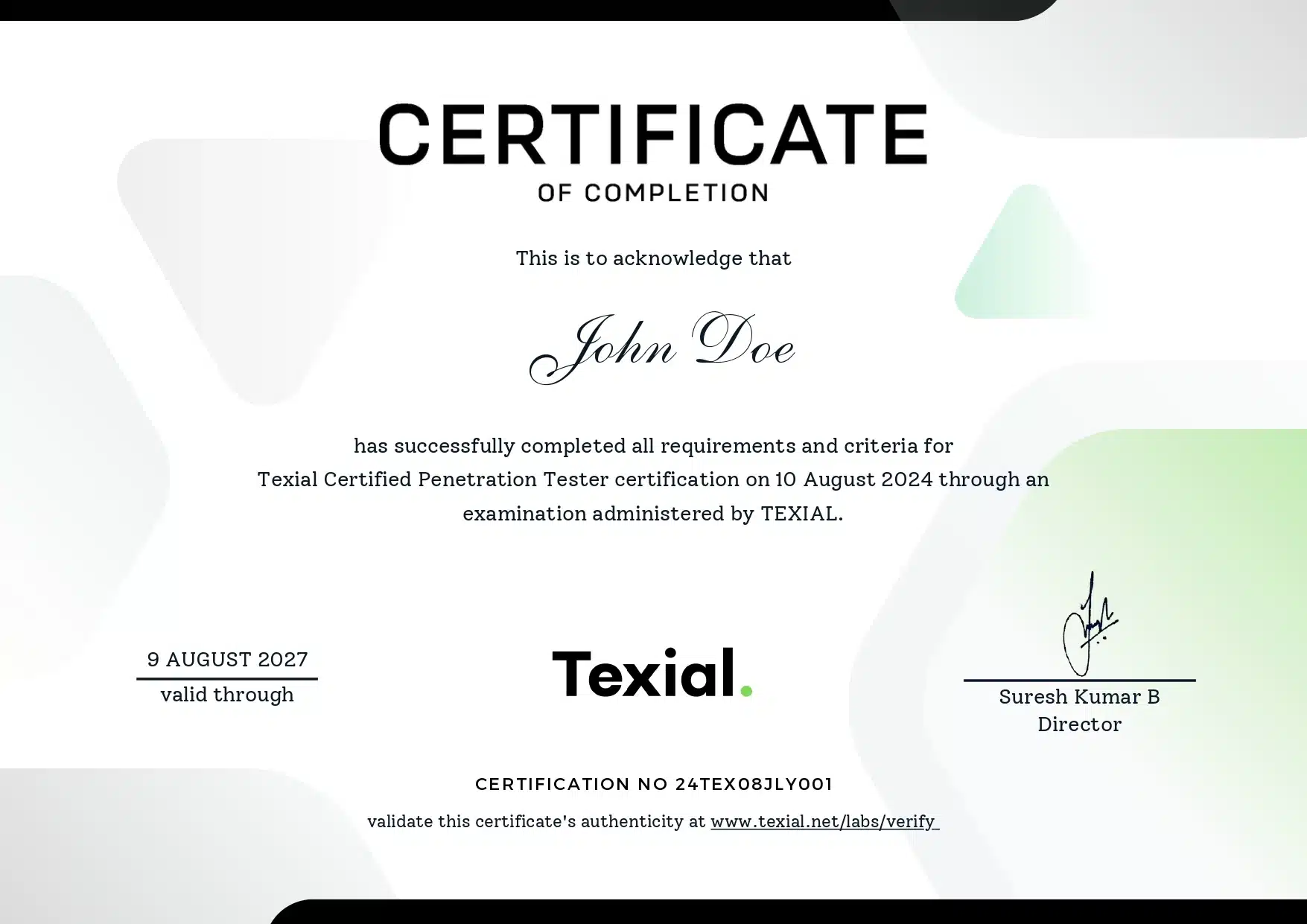
Texial Certified Penentration Tester
Become a Certified Penetration Testing Professional with Texial Certified Penentration Tester. For a penetration testers, the (TCPT) course is essential. It is the most thorough penetration testing training available in the world, giving information security experts the ability to find and take advantage of system flaws.
- Real-time attack & defense simulations
- Live sessions with cybersecurity experts
- Career-focused training & placement support
- Industry-aligned curriculum with Indian standards
Our Cyber Security Advisory
Dr. Venkatesan Selvam
Vice President, Texial Educationn
Dr. Venkatesan Selvam is having 22+ years of experience in the education sector. He is an executive director center for Cyber-physical System and Big data Analytics. Training and Placement Advisory Committee at Academic Council and Member in Research Board. An active member of ISTE, IACSIT, CSTA, IAENG, GATE. He has successfully published 70+ International Publications. Also published International Patent & National Patent. Recipient of Bharat Vibhushan Samman Puraskar award through the Economic and Human Resource Development Association.
Rajeev Jha
Cyber Expert, Board Member of Texial
Rajeev has 20+ years of experience in the Indian Air Force(IAF) as a head of Information Technology Infrastructure. Being a cyber lawyer he even possesses various certifications such as CISM | CISA | CSA | MS AZURE | ISO 27001LA | ITIL | CEH | ECSA | CND | CHFI. He is proficient in designing and implementing cyber compliance, handling high priority Incidents. Crisis management as well as Security Operations Center. As a Texial board member, he is responsible for verifying the quality and standard of education.
Premjith EJ
Cyber Expert, Board Member of Texial
Premjith being the Board Member of Texial is a strategist with 22 years of experience. An IIM alumnus previously associated with Reliance group, Hutchison Essar, and TATA Group of companies. He was a member of the Global Cyber Security Forum. His experience spans diverse verticals including Cyber Security, ISP, Telecom & IoT. He is the winner of the “TOP GUN AWARD -2015”, the most prestigious and the most coveted award in the TATA Group of Companies.
Premjith EJ
Cyber Expert, Board Member of Texial
Premjith being the Board Member of Texial is a strategist with 22 years of experience. An IIM alumnus previously associated with Reliance group, Hutchison Essar, and TATA Group of companies. He was a member of the Global Cyber Security Forum. His experience spans diverse verticals including Cyber Security, ISP, Telecom & IoT. He is the winner of the “TOP GUN AWARD -2015”, the most prestigious and the most coveted award in the TATA Group of Companies.
Our Cyber Security Advisory
Dr. Venkatesan Selvam
Vice President, Texial Educationn
Dr. Venkatesan Selvam is having 22+ years of experience in the education sector. He is an executive director center for Cyber-physical System and Big data Analytics. Training and Placement Advisory Committee at Academic Council and Member in Research Board. An active member of ISTE, IACSIT, CSTA, IAENG, GATE. He has successfully published 70+ International Publications. Also published International Patent & National Patent. Recipient of Bharat Vibhushan Samman Puraskar award through the Economic and Human Resource Development Association.
Rajeev Jha
Cyber Expert, Board Member of Texial
Rajeev has 20+ years of experience in the Indian Air Force(IAF) as a head of Information Technology Infrastructure. Being a cyber lawyer he even possesses various certifications such as CISM | CISA | CSA | MS AZURE | ISO 27001LA | ITIL | CEH | ECSA | CND | CHFI. He is proficient in designing and implementing cyber compliance, handling high priority Incidents. Crisis management as well as Security Operations Center. As a Texial board member, he is responsible for verifying the quality and standard of education.
Premjith EJ
Cyber Expert, Board Member of Texial
Premjith being the Board Member of Texial is a strategist with 22 years of experience. An IIM alumnus previously associated with Reliance group, Hutchison Essar, and TATA Group of companies. He was a member of the Global Cyber Security Forum. His experience spans diverse verticals including Cyber Security, ISP, Telecom & IoT. He is the winner of the “TOP GUN AWARD -2015”, the most prestigious and the most coveted award in the TATA Group of Companies.
Premjith EJ
Cyber Expert, Board Member of Texial
Premjith being the Board Member of Texial is a strategist with 22 years of experience. An IIM alumnus previously associated with Reliance group, Hutchison Essar, and TATA Group of companies. He was a member of the Global Cyber Security Forum. His experience spans diverse verticals including Cyber Security, ISP, Telecom & IoT. He is the winner of the “TOP GUN AWARD -2015”, the most prestigious and the most coveted award in the TATA Group of Companies.
Cyber Security Course Admission in Pune
Get a smooth and hassle-free enrollment experience:

Step 01
Submit the enquiry form or call us directly
Step 02
Attend free counselling with our program advisors
Step 03
Book your slot with flexible EMI or payment options
Start Learning Today
Start your cyber security journey today and secure your future in tech by gaining in-demand skills, hands-on experience, and industry-recognized certifications that prepare you to defend against modern digital threats and excel in a fast-growing career field.
Course Structure & Inclusions
- 300 Hours of comprehensive learning
- Career guidance, resume building, and placement assistance
- Hands-on labs and real-world simulations
Cyber Security Course in Pune
VAPT.
Ethical Hacking
- Information Gathering & Scanning
- Network & Web App Exploits
- Vulnerability Assessment
SOC Operations
- SIEM Tools (QRadar, Splunk)
- Threat Data & Detection
Log Watching, Incident response
CHFI.
Digital Forensics
- Disk, Email & Memory Forensics
- Evidence Collection & Chain of Custody
- Forensic Reporting for Legal Cases
CPENT.
Penetration Testing
- Exploiting enterprise-grade systems
- Evading IDS/IPS
- Live Hack Lab simulations
Start Your Cyber security Career
Join the elite group of certified Cyber Security hackers and secure your future in the fastest-growing, highest-paying sector of the IT industry.
- Placement Assistance
- Global Certification
- High Salary Growth
- Remote Work Options
Cyber Security Course in Pune Placement Cell
Job Placement
Companies come in often to hire people as cyber analysts.
Internships
Internships are important. We provide internship offers to improve your skills.
Resume Feedback
Our professionals will look at your resume and give feedback to create opportunities.
Career Counselling
Write down your skills and get advice from our experts to get the training in Pune.
Enroll to start your Cyber security Journey with Texial
Both working professionals and students can enroll in Texial’s cyber security course in Pune, which offers flexible in-person and online learning options.
So what are you waiting for? Enroll now and take the first step towards a rewarding career in cyber security. Contact us today to learn more about the course in detail.
Our Students Reviews
Vivek Gaonkar
Placed at QSEAP
Texial is a great place for beginners to know about cyber security, Had an awesome learning experience here. The Training and coaching staff are friendly and always there to clear our doubts.
Sahana S
Placed at Zerofox
The place where I gained confidence and knowledge in the field of cyber security. Trustworthy environment to get certified. I hope to see few more certifications.
Nikhil Vithal Ghorpade
Placed at Zerofox
The training was good. The trainers were helpful and friendly throughout the course. The learning experience was good, trainers made sure every concept was clearly understood.
Abhay RS
Placed at Zerofox
A very professional and great teaching with good practicals . And a very good choice to learn ethical hacking in Texial Cyber security even if you are from any stream . Good supportive teaching staffs for betterment of skills. Can have very good knowledge of basics of ethical hacking and there is no restrictions to learn. Happy and satisfied learning in Texial Cyber security
Shreyas N
Placed at QSEAP
I was lucky enough to get a highly supportive recruiter, helped me in identifying the right opportunities based on my background, briefed in detail about the interview procedures which made the whole process so smooth, also following up in a timely manner helped me with all the updates. Thanks to Team Texial, I was able to get a great offer. From my experience, I’d strongly recommend you to try and get certification from Texial Cyber Security .
Abhishek K K
Placed at Zerofox
Institution is very good, trainers are friendly. The teaching is fast and they also clear all the doubts. They support you until you get a job. Nice institution for freshers to learn about cyber security and Ethical hacking.
Viksha
Placed at KPMG
Good experience and great training center for cyber security. Can learn from scratch and delighted to score 124/125 in CEH v13 AI. Excellent and Happy learning in Texial Cyber security
Vivek Gaonkar
Placed at QSEAP
Texial is a great place for beginners to know about cyber security, Had an awesome learning experience here. The Training and coaching staff are friendly and always there to clear our doubts.
Sahana S
Placed at Zerofox
The place where I gained confidence and knowledge in the field of cyber security. Trustworthy environment to get certified. I hope to see few more certifications.
Nikhil Vithal Ghorpade
Placed at Zerofox
The training was good. The trainers were helpful and friendly throughout the course. The learning experience was good, trainers made sure every concept was clearly understood.
Abhay RS
Placed at Zerofox
A very professional and great teaching with good practicals . And a very good choice to learn ethical hacking in Texial Cyber security even if you are from any stream . Good supportive teaching staffs for betterment of skills. Can have very good knowledge of basics of ethical hacking and there is no restrictions to learn. Happy and satisfied learning in Texial Cyber security
Shreyas N
Placed at QSEAP
I was lucky enough to get a highly supportive recruiter, helped me in identifying the right opportunities based on my background, briefed in detail about the interview procedures which made the whole process so smooth, also following up in a timely manner helped me with all the updates. Thanks to Team Texial, I was able to get a great offer. From my experience, I’d strongly recommend you to try and get certification from Texial Cyber Security .
Abhishek K K
Placed at Zerofox
Institution is very good, trainers are friendly. The teaching is fast and they also clear all the doubts. They support you until you get a job. Nice institution for freshers to learn about cyber security and Ethical hacking.
Viksha
Placed at KPMG
Good experience and great training center for cyber security. Can learn from scratch and delighted to score 124/125 in CEH v13 AI. Excellent and Happy learning in Texial Cyber security
What does cyber security mean and why is it important?
Cyber security is the practice of keeping networks, systems, and data safe from threats that come from the internet. It is very important to stop data breaches, financial losses, and damage to your reputation.
Who Is Eligible to Take a Cybersecurity Course?
If you’re into tech, good at fixing stuff, and know your way around computers, we’d love to have you! Students, recent graduates, and working professionals with and without IT backgrounds are all welcome to apply.
Do I Need to Know Coding to Learn Cybersecurity?
Nope, You don’t need to code if you’re a beginner. The course starts with the basics and then moves on to more advanced stuff.
Will I Get Hands-On Training?
Indeed. With practical labs, real-world projects, and real-time attack simulations, this course will prepare you for the workforce.
Is a Career in Cyber security Beneficial in India?
The cyber security course starts simple and gets into the harder stuff as you go.
After the course, will I receive placement assistance?
Yes, We help you get a job by giving you access to hiring partners. Helping you prepare for interviews, and helping you find a job.
Will AI have an effect on the cyber security field?
By automating threat detection and response, AI is revolutionising cyber security, but it won’t take the place of cyber security experts. Rather, it will generate new positions in risk management, threat hunting, and AI-driven security analysis, increasing the value of qualified professionals.
Is a Pune Texial Cyber Security course appropriate for novices?
We start with the basics and then move on to more complex things. To begin the course, you do not need to have any prior technical knowledge.
Can I Do This Course While Working or in College?
Yes, Texial’s cyber security course in Pune has classes that fit your schedule. We have classes during the week, on weekends, and online. Classes are in the morning and evening, so pick what works for you.
Are there online options for cyber security courses in Pune?
Yes, depending on your preferences, you can choose between live online sessions and classroom instruction.
Why should I enrol in a cyber security course in Pune?
Pune is becoming a tech hotspot, and it’s a cool place to learn about cyber security. With good teachers, a strong IT setup, and exposure to leading companies, it’s a great spot to start or develop your cyber security career.
When I finish, do I receive a certificate?
Yes, you can get ready for international certifications in addition to receiving a certificate from the cyber security course.
What Makes Texial Unique?
Texial helps students start their career in cyber security by giving real-world training, experienced instructors, class times that work for you, and help finding a job.
Do businesses in Pune employ recent graduates of cyber security courses?
Indeed, a lot of startups, IT firms, and consulting firms employ recent graduates with cyber security training for entry-level security positions.
Is it possible for me to get an internship while taking the Cyber Security course?
Yes, students who finish the three-month or six-month program at Texial Cyber Security Course in Pune are eligible for internships.
Do businesses in Pune employ recent graduates of cyber security courses?
Indeed, a lot of startups, IT firms, and consulting firms employ recent graduates with cyber security training for entry-level security positions.
Contact Us
Training Consultant In Pune
Looking to build your career in cyber security? Connect with Texial’s Cyber Security Consultants today – just give us a call and our experts will guide you.