
Cyber Security Course | 6-Month Master Certification Program
Command the complete enterprise security lifecycle with Texial’s flagship Cyber Security Course. Engineered by practicing security architects and aligned with global EC-Council, NIST, and MITRE ATT&CK standards, this 6-month (300-hour) practitioner-led master program integrates four core disciplines—Information Security Auditing & Ethical Hacking (TISA / CEH v13 AI), Defensive SOC & SIEM Operations (TCSA), Digital Forensics (TCFI / CHFI), and Advanced Penetration Testing (TCPT / CPENT)—inside a 24/7 cloud-accessible Cyber Range.

Featured Across Leading Media






- Course Overview
Comprehensive Cyber Security Training — Mastering Red Team, Blue Team & Purple Team Operations
Modern enterprises no longer hire single-tool operators; they demand versatile cybersecurity engineers who understand how attacks are constructed, how breaches are detected in real time, and how digital evidence is preserved. Texial’s Cyber Security Certification Course is architected as an intensive 6-month, 300-hour career accelerator that transforms beginners and IT professionals into multi-disciplinary security practitioners.
Instead of isolating offensive and defensive concepts, our curriculum trains you across all three operational pillars of enterprise cyber defense: Red Team (Offensive Security) for vulnerability assessment, exploit development, and Active Directory/API penetration testing; Blue Team (Defensive Security & DFIR) for 24/7 SIEM monitoring, threat hunting, incident containment, and forensic evidence recovery; and Purple Team Operations to bridge offensive simulation with defensive detection engineering.
Over 70% of your training takes place inside our interactive Cloud Cyber Range using 600+ enterprise security utilities—including Splunk, IBM QRadar, Burp Suite Pro, Metasploit, Nmap, Wireshark, Hashcat, Autopsy, Volatility, and Cellebrite UFED. You will graduate with globally recognized multi-certification credentials, consulting-grade VAPT and forensic closure reports, and dedicated placement support.
Core Skills Covered
- Full-scope Network, Web Application (OWASP Top 10), REST/GraphQL API, and Active Directory Penetration Testing
- Security Operations Center (SOC) alert triage, SIEM log correlation, SOAR playbook automation, and Threat Hunting
- AI-assisted OSINT reconnaissance, attack-surface mapping, vulnerability prioritization, and custom exploit scripting
- Digital Forensics and Incident Response (DFIR) across Windows, Linux, macOS, Memory, Network, Cloud, and Mobile
- Static and dynamic reverse-engineering of ransomware, fileless malware (Emotet), and trojans in isolated sandboxes
- Enterprise security governance, regulatory compliance auditing (GDPR, PCI-DSS, ISO 27001, IT Act), and executive closure reporting
Texial Cyber Security Course Key Features
- 300 Hours (6 Months) of Live Instructor-Led Training (Classroom & Online)
- 4-Phase Modular Syllabus: Auditing, SOC, Forensics & Advanced Pentesting
- 70% Practical Execution in Multi-Layered Cloud Cyber Range Labs
- Hands-On Mastery of 600+ Offensive, SIEM, EDR & Forensic Tools
- Mentorship by Accredited Security Architects, SOC Leads & DFIR Investigators
- Multi-Certification Track (TISA, TCSA, TCFI, TCPT & EC-Council Pathways)
- Dedicated Global Career Cell, Internships & 100% Placement Support
- Live Red Team vs. Blue Team Cyber Range Drills & CTF Tournaments
- 24/7 Cloud Lab Access & Recorded LMS Portal for Flexible Revision
- Real-World Capstone VAPT Audits, SIEM Use-Cases & Forensic Reports
Eligibility and Pre-requisites
- Zero Prior Cybersecurity or Coding Background Required: Our 4-phase master syllabus builds systematically from foundational TCP/IP networking, Linux, and OS internals up to advanced exploitation and SIEM engineering.
- University Students & Fresh Graduates: B.E./B.Tech, BCA, MCA, and B.Sc. (Computer Science/IT) learners seeking an end-to-end, job-ready launchpad into VAPT, SOC Analyst, and Digital Forensics careers.
- Working IT, Networking & QA Professionals: System administrators, network engineers, cloud administrators, software developers, and QA analysts pivoting into high-growth offensive or defensive cybersecurity roles.
- Enterprise Security Leads, Auditors & Founders: IT managers and compliance officers looking to harden enterprise infrastructure, lead internal SOC/VAPT teams, and meet global security mandates.
Our Cyber Security Training Formats
- In-Person Classroom Training
- Instructor-Led Immersive Batches at Texial’s Physical Training Centers
- Direct Lab Mentorship, Live Red/Blue Team Simulations & Peer Networking
Combine Live Classroom & Online Sessions with 24/7 Self-Paced LMS Access
Flexible Weekday, Evening & Weekend Schedules for Students and Working Pros
- 100% Live Interactive Online Sessions Accessible Worldwide
- Real-Time Doubt Resolution & 24/7 Browser-Based Cloud Cyber Range Labs
- Global Online Access Across All Timezones
- Operational Framework
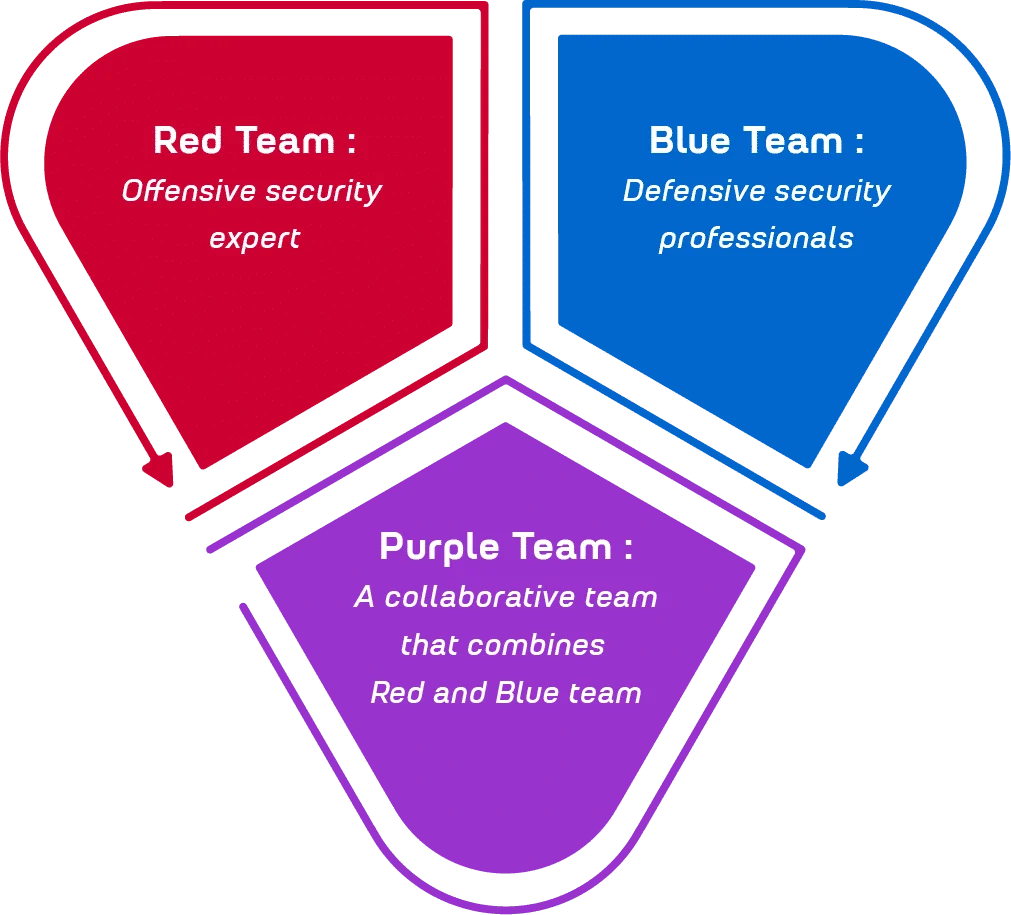
Types of Cyber Security Teams: Red, Blue & Purple Team Operations
Modern enterprises divide their cybersecurity operations into specialized offensive, defensive, and collaborative units. Texial’s Cyber Security Course is uniquely engineered to train you across all three operational domains so you can qualify for twice as many job roles.
Types of Cyber Security Teams
Red Team (Offensive Security & Adversary Simulation)
Red Teams act as ethical adversaries who stress-test an organization’s security posture by simulating real-world cyberattacks, Advanced Persistent Threats (APTs), and insider breaches. Rather than waiting for malicious hackers to strike, Red Team operators proactively uncover, chain, and exploit vulnerabilities across enterprise networks, web applications, APIs, cloud workloads, and human personnel.
Core Red Team Workflows You Will Master:
- AI-Augmented OSINT & Attack Surface Mapping: Harvesting open-source intelligence, enumerating subdomains, exposed cloud storage, and employee attack surfaces using ShellGPT, ReconAI, Maltego, and Nmap.
- Web Application & API Exploitation: Auditing OWASP Top 10 flaws, SQL Injection (SQLi), Cross-Site Scripting (XSS), REST/GraphQL API vulnerabilities, and JSON Web Token (JWT) manipulation.
- Network & Active Directory Penetration Testing: Executing initial access payloads, privilege escalation, Kerberoasting, Pass-the-Hash, lateral movement, and multi-subnet pivoting across Windows Active Directory and Linux servers.
- Perimeter Evasion & Custom Exploit Scripting: Bypassing Next-Gen Firewalls (NGFW), Web Application Firewalls (WAF), and IDS/IPS sensors using custom payload obfuscation, packet fragmentation, and HTTP/DNS tunneling.
Primary Tools & Frameworks: Kali Linux, Burp Suite Pro, OWASP ZAP, Metasploit Framework, Nmap, SQLmap, Nessus, OpenVAS, Hashcat, Aircrack-ng, Social-Engineer Toolkit (SET), and OWASP/PTES standards.
Texial Track & Target Job Roles: Covered in Phase 1 (TISA / CEH v13 AI) and Phase 4 (TCPT / CPENT). Prepares you for roles as a Penetration Tester, VAPT Analyst, Red Team Operator, Application/API Security Engineer, and Bug Bounty Researcher.
Purple Team (Collaborative Defense & Detection Engineering)
Purple Teaming bridges offensive Red Team attack simulations directly with defensive Blue Team detection engineering in real time. Instead of offensive and defensive teams working in isolated silos, Purple Team practitioners launch controlled exploits inside a cyber range while simultaneously analyzing the resulting logs, network packets, and EDR alerts—tuning security controls to slash Mean Time to Detect (MTTD) and Mean Time to Respond (MTTR).
Core Purple Team Workflows You Will Master:
- Adversary Emulation & MITRE ATT&CK Mapping: Replicating end-to-end attack kill chains (from initial phishing and API exploitation to Active Directory lateral movement) to verify whether each adversary technique triggers a high-priority SOC alert.
- Detection Engineering & Signature Authoring: Translating observed Red Team exploit patterns into custom SIEM correlation rules (SPL/KQL), SIGMA rules, YARA malware signatures, and IDS/WAF policies while eliminating false positives.
- Telemetry & Visibility Gap Remediation: Auditing Windows Event Logs, Linux audit logs, and cloud trails to uncover blind spots where encrypted C2 tunneling or fileless malware bypassed existing security sensors.
- Executive Reporting & Regulatory Alignment: Documenting unified VAPT closure reports, SOC maturity metrics, and compliance evidence for ISO/IEC 27001, PCI-DSS, GDPR, CERT-In, and the Indian IT Act.
Primary Tools & Frameworks: MITRE ATT&CK & MITRE D3FEND Matrices, Cyber Kill Chain, Splunk/QRadar Detection Pipelines, Burp Suite + WAF Log Correlation, Wireshark Deep-Packet Inspection, YARA/SIGMA, and SOAR Automation.
Texial Track & Target Job Roles: Mastered by combining all 4 phases of Texial’s 6-Month Cyber Security Master Program (TISA + TCSA + TCFI + TCPT). Prepares you for senior roles as a Purple Team Engineer, Detection Engineer, Cyber Defense Consultant, SecOps Engineer, and Security Architect.
Blue Team (Defensive Security, SOC & Digital Forensics / DFIR)
Blue Teams serve as an enterprise’s 24/7 front-line cyber defenders and forensic investigators. Operating inside a Security Operations Center (SOC) and Incident Response Team (CSIRT), Blue Team specialists continuously monitor network and endpoint telemetry, triage high-priority alerts, hunt stealthy intruders, contain active breaches, and preserve legally admissible digital evidence.
Core Blue Team & DFIR Workflows You Will Master:
- 24/7 SIEM Log Correlation & Alert Triage: Ingesting, parsing, and correlating millions of events from Windows Active Directory, Linux syslogs, firewalls, and cloud workloads using Splunk, IBM QRadar, Microsoft Sentinel, and the ELK Stack.
- Threat Intelligence (CTI) & Proactive Threat Hunting: Operationalizing threat feeds (VirusTotal, Cisco Talos, AlienVault OTX) and hunting Indicators of Compromise (IoCs) mapped to the MITRE ATT&CK framework.
- Incident Response & SOAR Playbook Automation: Executing the NIST incident response lifecycle—isolating compromised hosts, eradicating persistence mechanisms, and automating triage workflows via SOAR runbooks.
- Multi-Platform Digital Forensics & Malware Analysis: Performing bit-stream disk acquisition, Windows/Linux/macOS artifact recovery, volatile RAM analysis, Dark Web (Tor) investigation, mobile forensics, and static/dynamic reverse-engineering of ransomware and fileless malware (Emotet).
Primary Tools & Frameworks: Splunk Enterprise, IBM QRadar, Wireshark, Autopsy, The Sleuth Kit (TSK), Volatility Framework, FTK, Cellebrite UFED, MOBILedit, OSForensics, VirusTotal, Cisco Talos, YARA, SIGMA rules, and NIST CSF 2.0.
Texial Track & Target Job Roles: Covered in Phase 2 (TCSA / CSA) and Phase 3 (TCFI / CHFI). Prepares you for roles as a Tier 1 & Tier 2 SOC Analyst, Incident Responder, SIEM Engineer, Threat Hunter, Digital Forensic Investigator, and Malware Analyst.
Cyber Security Course — 6-Month Specialization Tracks & Options
Texial’s 6-Month Cyber Security Master Program is architected to give you deep, hands-on command across the four core domains of modern cyber defense: Ethical Hacking & Security Auditing, SOC & SIEM Operations, Digital Forensics (DFIR), and Advanced Penetration Testing. Depending on your career goals, choose between our Offensive Penetration Testing track, our Defensive & Digital Forensics track, or customized Enterprise training.
Master Program in Cyber Security with Penetration Testing
- Penetration Testing
- Ethical Hacking
- SOC Analyst
Designed for aspiring Red Teamers, VAPT analysts, and offensive security engineers, this 6-month (300-hour) master track combines foundational training in Ethical Hacking (TISA / CEH v13 AI) and SOC Operations (TCSA / CSA) with advanced specialization in Enterprise Penetration Testing (TCPT / CPENT). You will progress from network enumeration to multi-subnet pivoting, Active Directory exploitation, and API/web-app pentesting inside our live Cyber Range.
6-Month Offensive & Red Team Track
- 3-in-1 Master Curriculum: Ethical Hacking (TISA/CEH) + SOC (TCSA) + Pentesting (TCPT/CPENT)
- 300 hours of live instructor-led training with 24/7 Cloud Cyber Range access
- Advanced Web App (OWASP), REST/GraphQL API, and JWT exploitation labs
- Active Directory enumeration, privilege escalation, lateral movement & pivoting
- Perimeter defense evasion (IDS/IPS/WAF bypass) and custom exploit modification
- Includes multi-certification preparation, VAPT internship & 100% placement support
Master Program in Cyber Security with Digital Forensics
- Digital Forensic
- SOC Analyst
- Ethical Hacking
Engineered for aspiring Blue Teamers, SOC investigators, and DFIR specialists, this 6-month (300-hour) master track integrates Ethical Hacking (TISA / CEH v13 AI) and SOC & SIEM Analysis (TCSA / CSA) with deep-dive Computer Hacking Forensic Investigation (TCFI / CHFI). You will learn to uncover vulnerabilities, detect live intrusions via SIEM/EDR, and recover legally admissible digital evidence across disk, memory, network, cloud, and mobile environments.
6-Month Defensive, SOC & DFIR Track
- 3-in-1 Master Curriculum: Ethical Hacking (TISA/CEH) + SOC (TCSA) + Forensics (TCFI/CHFI)
- 300 hours of live instructor-led training with 24/7 Cloud Cyber Range access
- Real-time SIEM log correlation (Splunk/QRadar), Threat Intelligence & SOAR playbooks
- Hard disk, file system, Windows/Linux/macOS, and volatile memory forensics (Volatility/Autopsy)
- Static/dynamic malware analysis, Dark Web (Tor) forensics, AWS/Azure cloud & mobile forensics
- Includes multi-certification preparation, DFIR internship & 100% placement support
Enterprise & Corporate Cyber Defense Training
- Custom Red & Blue Bootcamps
- Enterprise Cyber Range Labs
- Compliance & Audit Readiness
Upskill your engineering, IT, and security operations teams with tailored corporate bootcamps aligned to your organization’s cloud, Active Directory, and SIEM architecture. We deliver private Red Team, Blue Team, Purple Team, and incident-response simulations—complete with executive skill-gap benchmarking and compliance readiness for ISO 27001, PCI-DSS, GDPR, RBI, and CERT-In mandates.
Customized to Your Organization’s Security Architecture
- Bespoke Red Team, Blue Team, Purple Team, and SOC maturity bootcamps
- Custom cyber range simulations mirroring your enterprise cloud and AD stack
- Flexible on-site corporate delivery or live virtual global cohorts
- Dedicated engagement director and accredited VAPT/SOC/DFIR instructors
- Pre- and post-training technical skill benchmarking and KPI reporting
- Regulatory readiness support for ISO 27001, PCI-DSS, GDPR, and CERT-In audits
Cyber Security Course Curriculum (4-Phase Master Syllabus)
Our 4-phase Cyber Security Master Curriculum is engineered to take you from foundational networking to enterprise-ready mastery. Phase 1 builds your offensive foundation in Information Security Auditing and Ethical Hacking (TISA / CEH v13 AI); Phase 2 trains you in Defensive Security Operations and SIEM (TCSA); Phase 3 masters Computer Hacking Forensic Investigation (TCFI / CHFI); and Phase 4 advances into Enterprise Penetration Testing (TCPT / CPENT).
Module 1. Introduction to Ethical Hacking and Cyber Security
- Introduction to Cyber Security
- Goals and Boundaries
- Introduction to Hacking
- Phases of Hacking
- Approaches of a Hacker
Module 2. Network Fundamentals
- Basics of Networks
- Introduction to IP address, MAC address, Web server
- Changing IP address with Tor
- Changing IP address with VPN
- Changing IP address with Proxy Server
- Changing MAC address
- Working of Web Servers
- Brief idea about DNS leaks
- Being completely Anonymous
Module 3. Information Gathering
- Introduction to Information gathering
- Information gathering approach
- Types of Information gathering
- WHOIS Lookup
- Introduction to Google Dorks
- Introduction to robots.txt
- Information gathering using Wayback Machine
- Information gathering using Netcraft
- Information gathering using Wappalyzer
- Information gathering using Maltego
- Information gathering using Metagoofil
- Approaches to find email address
- Compiling and Analysis of the Information gathered
Module 4. Scanning and Enumeration
- Introduction to scanning approaches
- Types of scanning and TCP connection flags
- Checking for systems power
- Port scanning using Nmap
- Port scanning using netdiscover
- Port scanning using Angry IP Scanner
- Nmap Port or service scanning
- Operating System scan using Nmap
- Aggressive and advanced scan using Nmap
- IP scanning using Nmap
Module 5. Vulnerability Assessment
- Introduction to Vulnerability scanner
- Types of Vulnerabilities
- Vulnerability Assessment using Nmap
- Vulnerability Assessment using Nessus
- Vulnerability Assessment using OpenVAS
Module 6. Operating System Penetration Testing
- Introduction to OS
- Introduction to Metasploit Framework
- Introduction to Exploit, Payload, Post, Auxiliary and nops
- Finding exploits using searchsploit
- Exploitation of Windows XP
- Privilege escalation exploit code for Windows 7
- Mozilla Firefox Universal exploit
- Exploitation of Windows 8
- Exploitation of Windows 10
Module 7. Malware, Viruses and Trojans
- Introduction to Viruses, Malware and Trojan
- Types of Viruses
- Creation of custom Malware, Virus and Trojan with automated tool
- Protection from Virus, Malware and Trojan
Module 8. Social Engineering
- Introduction to social engineering
- Types of social engineering attacks
- Creating phishing page and methodology
- Protection from social engineering attacks
Module 9. Mobile Vulnerability Exposure and Exploitation
- Introduction to android and iOS
- Security flaws of android and iOS
- Gaining complete access of the system using msfvenom
- Call Spoofing
- SMS Spoofing
Module 10. Wireless Penetration Testing
- Working of WIFI
- Types of WIFI security
- Hacking WEP using wifite or the reaver
- Hacking wpa/wpa2 using aircrack-ng
- Wireless Technology standards, Interference, Encryption
Module 11. Web Application Penetration Testing
- Introduction to Web Application
- Types of web servers
- Types of Attacks
- Introduction to Cross-site scripting
- Understanding OWASP TOP 10
- Web Application Vulnerability Assessment using Vega
- Web App Vulnerability Assessment using OWASP ZAP
- Web App Firewall Detection using wafw00f
- Web App penetration using Burp Suite
- Types of Cross-site scripting
- Local file inclusion vulnerability
- Exploiting vulnerabilities in DVWA
Module 12. Database Penetration Testing
- Introduction to Database
- SQL database
- SQL queries
- Types and Purpose
- Introduction to SQL injection
- SQL injection using SQLmap
- Finding SQL-Injectable Websites
- Live Demonstration of SQL Injection
- Safe practice with SQL injection
Module 13. Denial-of-service
- Introduction to DoS and DDoS Attacks
- DoS and DDoS Attack Techniques
- How to secure from the attack
Module 14. Applied Cryptography
- Introduction to Cryptography
- Types of Cryptography
- Symmetric Key Cryptography
- Asymmetric Key Cryptography
Module 15. Cryptocurrency
- Introduction and Types of Cryptocurrency
- Introduction to Blockchain
- Bitcoin
Module 16. Fundamentals of Ransomware
- Introduction to Ransomware
- Analysis of Ransomware
- Countermeasures
Module 17. Dark Web
- Introduction to surface web, deep web and dark web
- Features of Deep Web
- Legality in Deep Web
- Details of Dark Web
- Legality in Dark Web
- Deep web vs. dark web
Module 18. Indian IT Act
- Details of the Act
- Importance of Cyber Law
Module 19. Bug Bounty
- Introduction to Bug Bounty
- Scope, Target, and Out of Scope
- Disclosure Terms & Rules and Reward
Module 20. Closure Report
- Professional report
- Writing Format
- Do’s and Don’ts
Module 1: Fundamentals of CySec and Networking
- OS & TCP/IP Model,DNS, 3 Way Handshake
- Firewall, IPS/IDS, DLP, End Point Security
- CIA Triad
- DOS, XSS, SQLi
- Malware Attacks
- Phishing
Module 2: Introduction to SOC and DefSec
- Introduction to Defensive Security Operations
- Classic Defensive Security Technologies
- NIST Cyber Security Framework
- Overview of a SOC
- Modern SOC Technologies
- Objectives and responsibilities of a SOC
- SOC infrastructure
- Roles and responsibilities within a SOC
- SOC processes and procedures
Module 3: Cyber Threats, IoCs, and Attack Methodology
- Types of cyber threats
- Indicators of Compromise (IoCs)
- Cyber kill chain methodology
- Attack vectors and methods
- Understanding and analyzing attack patterns
Module 4: Incident Detection with Security Information and Event Management (SIEM)
- Introduction to SIEM
- SIEM architecture and components
- Log management and analysis
- Configuring and tuning SIEM tools
- Correlation rules and use cases
Module 5: Enhanced Incident Detection with Threat Intelligence
- Understanding threat intelligence
- Types and sources of threat intelligence
- Integrating threat intelligence with SIEM
- Using threat intelligence for proactive detection
- Threat intelligence platforms and tools
Module 6: Incident Response and Handling
- Incident response process and lifecycle
- Preparation for incident response
- Detection and analysis of incidents
- Containment, eradication, and recovery
- Post-incident activities and reporting
Module 7: Understanding SOC Workflow and Automation
- SOC workflow and processes
- Automating SOC tasks
- Introduction to SOAR (Security Orchestration, Automation, and Response)
- Developing playbooks and runbooks
- Case studies on SOC automation
Module 8: Building and Maturing a SOC
- Setting up a SOC
- Staffing and training SOC analysts
- SOC metrics and KPIs
- Continuous improvement and maturity models
- Best practices for a successful SOC
Module 9: Network Forensics
- Network Traffic Analysis
- Intrusion Detection Prevention Systems
- Email and Malicious URL Analysis
- Root cause analysis techniques
Module 10: Compliances
- Understanding regulatory requirements
- Compliance frameworks and standards (e.g., GDPR, PCI-DSS)
- Ensuring SOC compliance
- Impact of compliance on SOC operations
- Auditing and assessment
Module 01: Computer Forensics in Today’s World
- Understand the Fundamentals of Computer Forensics
- Understand Cybercrimes and their Investigation Procedures
- Understand Digital Evidence
- Understand Forensic Readiness, Incident Response and the Role of SOC (Security Operations Center) in Computer Forensics
- Identify the Roles and Responsibilities of a Forensic Investigator
- Understand the Challenges Faced in Investigating Cybercrimes
Module 02: Computer Forensics Investigation Process
- Understand the Forensic Investigation Process and its Importance
- Understand the Pre-investigation Phase
- Understand First Response
- Understand the Investigation Phase
- Understand the Post-investigation Phase
Module 03: Understanding Hard Disks and File Systems
- Describe Different Types of Disk Drives and their Characteristics
- Explain the Logical Structure of a Disk
- Understand Booting Process of Windows, Linux and Mac Operating Systems
- Understand Various File Systems of Windows, Linux and Mac Operating Systems
- Examine File System Using Autopsy and The Sleuth Kit Tools
- Understand Storage Systems
- Understand Encoding Standards and Hex Editors
- Analyze Popular File Formats Using Hex Editor
Module 04: Data Acquisition and Duplication
- Understand Data Acquisition Fundamentals
- Understand Data Acquisition Methodology
- Prepare an Image File for Examination
Module 05: Defeating Anti-Forensics Techniques
- Understand Anti-forensics Techniques
- Discuss Data Deletion and Recycle Bin Forensics
- Illustrate File Carving Techniques and Ways to Recover Evidence from Deleted Partitions
- Explore Password Cracking/Bypassing Techniques
- Detect Steganography, Hidden Data in File System Structures, Trail Obfuscation, and File Extension Mismatch
- Understand Techniques of Artifact Wiping, Overwritten Data/Metadata Detection, and Encryption
- Detect Program Packers and Footprint Minimizing Techniques
- Understand Anti-forensics Countermeasures
Module 06: Windows Forensics
- Collect Volatile and Non-volatile Information
- Perform Windows Memory and Registry Analysis
- Examine the Cache, Cookie and History Recorded in Web Browsers
- Examine Windows Files and Metadata
- Understand ShellBags, LNK Files, and Jump Lists
- Understand Text-based Logs and Windows Event Logs
Module 07: Linux and Mac Forensics
- Understand Volatile and Non-volatile Data in Linux
- Analyze Filesystem Images Using The Sleuth Kit
- Demonstrate Memory Forensics Using Volatility & PhotoRec
- Understand Mac Forensics
Module 08: Network Forensics
- Understand Network Forensics
- Explain Logging Fundamentals and Network Forensic Readiness
- Summarize Event Correlation Concepts
- Identify Indicators of Compromise (IoCs) from Network Logs
- Investigate Network Traffic
- Perform Incident Detection and Examination with SIEM Tools
- Monitor and Detect Wireless Network Attacks
Module 09: Investigating Web Attacks
- Understand Web Application Forensics
- Understand Internet Information Services (IIS) Logs
- Understand Apache Web Server Logs
- Understand the Functionality of Intrusion Detection System (IDS)
- Understand the Functionality of Web Application Firewall (WAF)
- Investigate Web Attacks on Windows-based Servers
- Detect and Investigate Various Attacks on Web Applications
Module 10: Dark Web Forensics
- Understand the Dark Web
- Determine How to Identify the Traces of Tor Browser during Investigation
- Perform Tor Browser Forensics
Module 11: Database Forensics
- Understand Database Forensics and its Importance
- Determine Data Storage and Database Evidence Repositories in MSSQL Server
- Collect Evidence Files on MSSQL Server
- Perform MSSQL Forensics
- Understand Internal Architecture of MySQL and Structure of Data Directory
- Understand Information Schema and List MySQL Utilities for Performing Forensic Analysis
- Perform MySQL Forensics on WordPress Web Application Database
Module 12: Cloud Forensics
- Understand the Basic Cloud Computing Concepts
- Understand Cloud Forensics
- Understand the Fundamentals of Amazon Web Services (AWS)
- Determine How to Investigate Security Incidents in AWS
- Understand the Fundamentals of Microsoft Azure
- Determine How to Investigate Security Incidents in Azure
- Understand Forensic Methodologies for Containers and Microservices
Module 13: Investigating Email Crimes
- Understand Email Basics
- Understand Email Crime Investigation and its Steps
- U.S. Laws Against Email Crime
Module 14: Malware Forensics
- Define Malware and Identify the Common Techniques Attackers Use to Spread Malware
- Understand Malware Forensics Fundamentals and Recognize Types of Malware Analysis
- Understand and Perform Static Analysis of Malware
- Analyze Suspicious Word and PDF Documents
- Understand Dynamic Malware Analysis Fundamentals and Approaches
- Analyze Malware Behavior on System Properties in Real-time
- Analyze Malware Behavior on Network in Real-time
- Describe Fileless Malware Attacks and How they Happen
- Perform Fileless Malware Analysis – Emotet
Module 15: Mobile Forensics
- Understand the Importance of Mobile Device Forensics
- Illustrate Architectural Layers and Boot Processes of Android and iOS Devices
- Explain the Steps Involved in Mobile Forensics Process
- Investigate Cellular Network Data
- Understand SIM File System and its Data Acquisition Method
- Illustrate Phone Locks and Discuss Rooting of Android and Jailbreaking of iOS Devices
- Perform Logical Acquisition on Android and iOS Devices
- Perform Physical Acquisition on Android and iOS Devices
- Discuss Mobile Forensics Challenges and Prepare Investigation Report
Module 16: IoT Forensics
- Understand IoT and IoT Security Problems
- Recognize Different Types of IoT Threats
- Understand IoT Forensics
- Perform Forensics on IoT Devices
Module 01 - Introduction to Penetration Testing and Methodologies
- Principles and Objectives of Penetration Testing
- Penetration Testing Methodologies and Frameworks
- Best Practices and Guidelines for Penetration Testing
- Role of Artificial Intelligence in Penetration Testing
- Role of Penetration Testing in Compliance with Laws, Acts, and Standards
Module 02 - Incidents, Events, and Logging
- Penetration Testing: Pre-engagement Activities
- Key Elements Required to Respond to Penetration Testing RFPs
- Drafting Effective Rules of Engagement (ROE)
- Legal and Regulatory Considerations Critical to Penetration Testing
- Resources and Tools for Successful Penetration Testing
- Strategies to Effectively Manage Scope Creep
Module 03 - Open-Source Intelligence (OSINT) and Attack Surface Mapping
- Collect Open-Source Intelligence (OSINT) on Target’s Domain Name
- Collect OSINT About Target Organization on the Web
- Perform OSINT on Target’s Employees
- OSINT Using Automation Tools
- Map the Attack Surface
Module 04 - Social Engineering Penetration Testing
- Social Engineering Penetration Testing Concepts
- Off-Site Social Engineering Penetration Testing
- On-Site Social Engineering Penetration Testing
- Document Findings with Countermeasure Recommendations
- Sniff credentials using the Social-Engineer Toolkit (SET)
Module 05 - Web Application Penetration Testing
- Web Application Footprinting and Enumeration Techniques
- Techniques for Web Vulnerability Scanning
- Test for Vulnerabilities in Application Deployment and Configuration
- Techniques to Assess Identity Management, Authentication, and Mechanisms
- Evaluate Session Management Security
- Evaluate Input Validation Mechanisms
- Detect and Exploit SQL Injection Vulnerabilities
- Techniques for Identifying and Testing Injection Vulnerabilities
- Exploit Improper Error Handling Vulnerabilities
- Identify Weak Cryptography Vulnerabilities
- Test for Business Logic Flaws in Web Applications
- Evaluate Applications for Client-Side Vulnerabilities
- Perform Website Footprinting
- Perform Web Vulnerability Scanning Using AI
- Perform Various Attacks on Target Web Application
Module 06 -API and JSON Web Token (JWT) Penetration Testing
- Techniques and Tools to Perform API Reconnaissance
- Test APIs for Authentication and Authorization Vulnerabilities
- Evaluate the Security of JSON Web Tokens (JWT)
- Test APIs for Input Validation and Injection Vulnerabilities
- Test APIs for Security Misconfiguration Vulnerabilities
- Test APIs for Rate Limiting and Denial of Service (DoS) Attacks
- Test APIs for Security of GraphQL Implementations
- Test APIs for Business Logic Flaws and Session Management
- Perform API Reconnaissance Using AI
- Scan and Identify Vulnerabilities in APIs
- Exploit Various Vulnerabilities to Gather Information on the Target Application
Module 07 - Perimeter Defense Evasion Techniques
- Techniques to Evaluate Firewall Security Implementations
- Techniques to Evaluate IDS Security Implementations
- Techniques to Evaluate the Security of Routers
- Techniques to Evaluate the Security of Switches
- Identify and Bypass a Firewall
- Evade Firewall and IDS Controls Using HTTP Tunneling and Packet Fragmentation
- Perform WAF Fingerprinting
Module 08 - Linux Exploitation and Privilege Escalation
- Linux Exploitation and Penetration Testing Methodologies
- Linux Reconnaissance and Vulnerability Scanning
- Techniques to Gain Initial Access to Linux Systems
- Linux Privilege Escalation Techniques
- Perform Reconnaissance and Vulnerability Assessment on Linux
- Gain Access and Perform Enumeration
- Identify Misconfigurations for Privilege Escalation
Module 09 - Windows Exploitation and Privilege Escalation
- Windows Pen Testing Methodology
- Techniques to Perform Reconnaissance on a Windows Target
- Techniques to Perform Vulnerability Assessment and Exploit Verification
- Methods to Gain Initial Access to Windows Systems
- Techniques to Perform Enumeration with User Privilege
- Techniques to Perform Privilege Escalation
- Post-Exploitation Activities
- Exploit Windows OS Vulnerability
- Exploit and Escalate Privileges on a Windows Operating System
- Gain Access to a Remote System
- Exploit Buffer Overflow Vulnerability on a Windows Machine
Module 10 - Active Directory Penetration Testing
- Architecture and Components of Active Directory
- Active Directory Reconnaissance
- Active Directory Enumeration
- Exploit Identified Active Directory Vulnerabilities
- Role of Artificial Intelligence in AD Penetration Testing Strategies
- Explore the Active Directory Environment
- Perform Active Directory Enumeration
- Perform Horizontal Privilege Escalation and Lateral Movement
- Retrieve Cached Active Directory Credentials
Module 11 - Lateral Movement and Pivoting
- Advanced Lateral Movement Techniques
- Advanced Pivoting and Tunneling Techniques to Maintain Access
- Perform Pivoting
- Perform DNS Tunneling and HTTP/SSH Tunneling
Module 12 - Report Writing
- Purpose and Structure of a Penetration Testing Report
- Essential Components of a Penetration Testing Report
- Phases of a Pen Test Report Writing
- Skills to Deliver a Penetration Testing Report Effectively
- Generate Penetration Test Reports
Earn Globally Recognized Cyber Security Certifications
Validate your hands-on capability across both offensive and defensive domains with credentials that pass enterprise HR filters and rigorous CISO technical panels. Depending on your specialization track, Texial prepares you for our practitioner certifications alongside official EC-Council global credentials:
- Texial Information Security Auditor (TISA) & EC-Council Certified Ethical Hacker (CEH v13 AI)
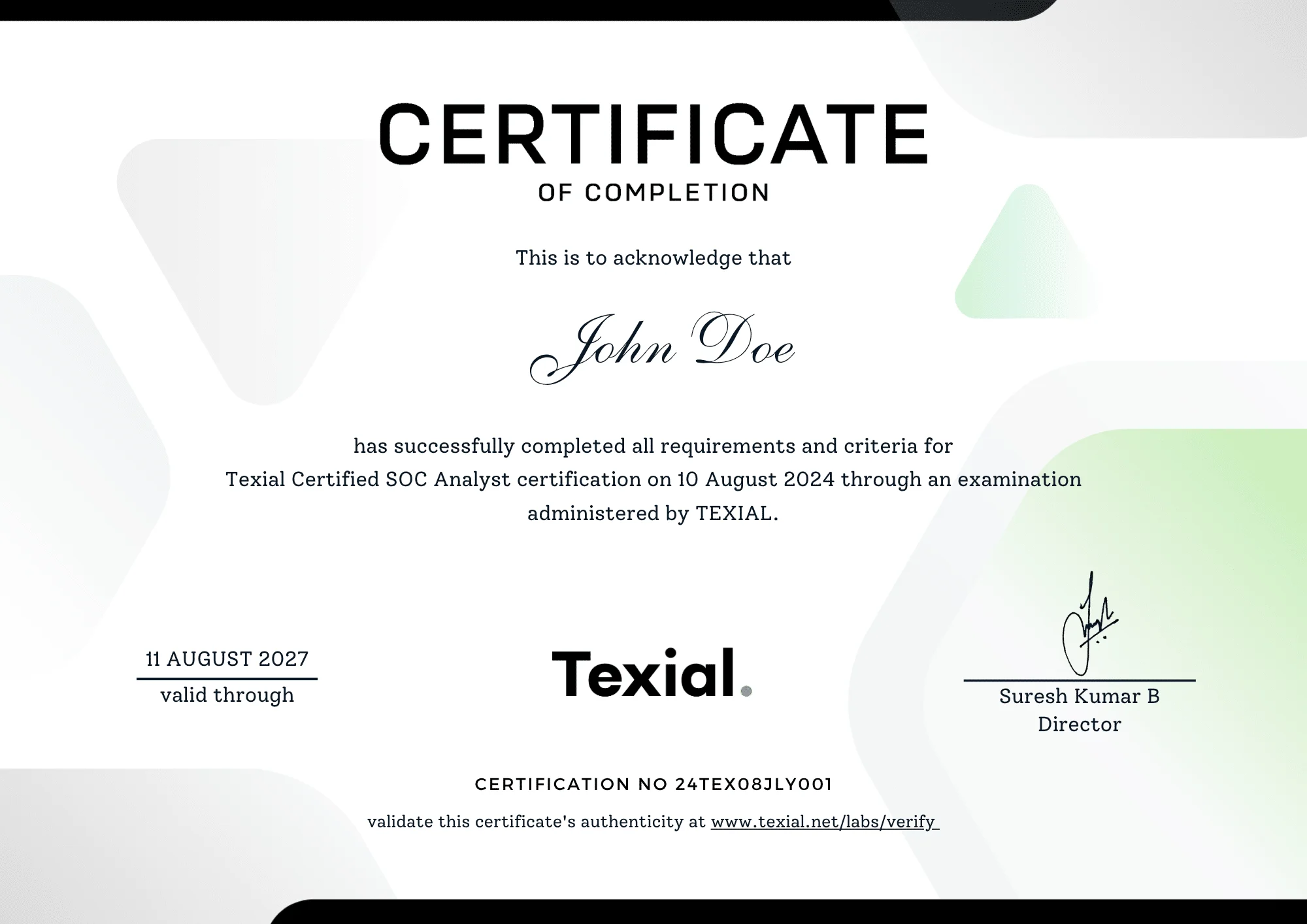
- Texial Certified SOC Analyst (TCSA) — SIEM, Threat Intelligence & Incident Response Credential
- Texial Certified Forensic Investigator (TCFI) & Computer Hacking Forensic Investigator (CHFI)
- Texial Certified Penetration Tester (TCPT) & Certified Penetration Testing Professional (CPENT)
Texial Information Security Auditor
Engineered for offensive security practitioners, the Texial Information Security Auditor (TISA) program combines foundational vulnerability assessment theory with intensive, live-fire exploitation labs. Learners master network reconnaissance, OWASP web auditing, Dark Web intelligence, Bug Bounty methodology, and consulting-grade VAPT closure reporting.
- Focus on Both Strategy & Tools
- Live interaction with Cyber Security Experts
- Career guidance and support
- Industry-driven comprehensive curriculum with Indian Standards

Texial Certified SOC Analyst (TCSA)
The Texial Certified SOC Analyst program is designed to prepare students with the right balance of theory and practice required to excel in Security Operations Centers (SOC). This cyber security course covers all the advanced SIEM, threat-hunting, and incident-response concepts.
- 4-Hour Practical SIEM & Incident Triage Exam
- Live Attack Detection Across Windows, Linux & Cloud Logs
- SOAR Playbook & Network PCAP Investigation Mastery cybersecurity experts
- Verifiable Credential for L1/L2 SOC Technical Panels
Texial Certified Forensic Investigator
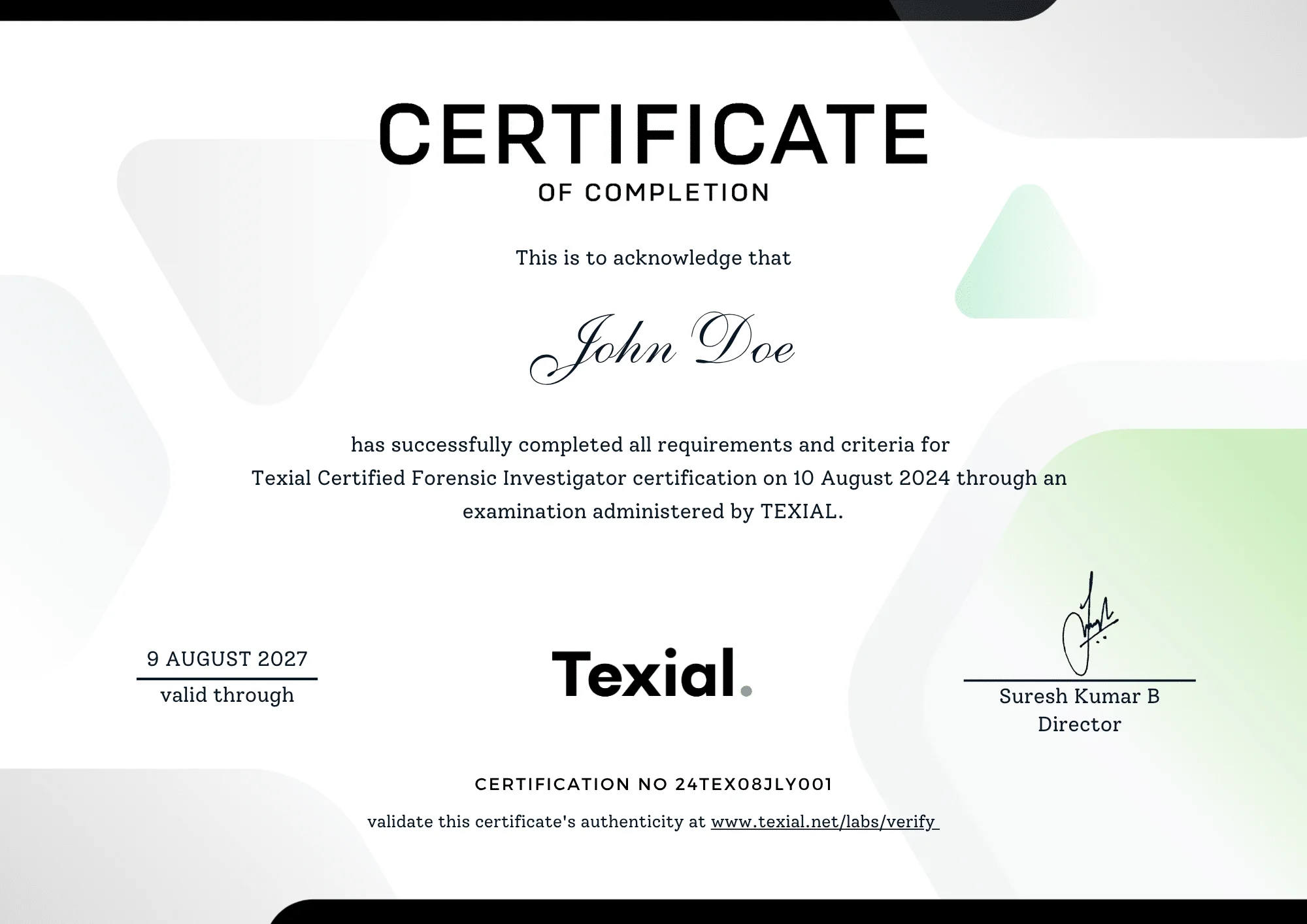
The Texial Certified Forensic Investigator (TCFI) and EC-Council CHFI track equips digital forensic examiners and incident responders with the technical methodology to seize, preserve, and analyze digital evidence across Windows, Linux, macOS, volatile memory, network traffic, cloud workloads, and mobile devices.
- Globally Recognized DFIR & Cyber Crime Investigation Track
- Hands-On Disk, Memory, Network, Cloud & Mobile Forensics Labs
- Prepares You for Texial TCFI & EC-Council CHFI Credentials
- Chain-of-Custody Documentation & Forensic Report Writing
Texial Certified Penetration Tester - (TCPT)
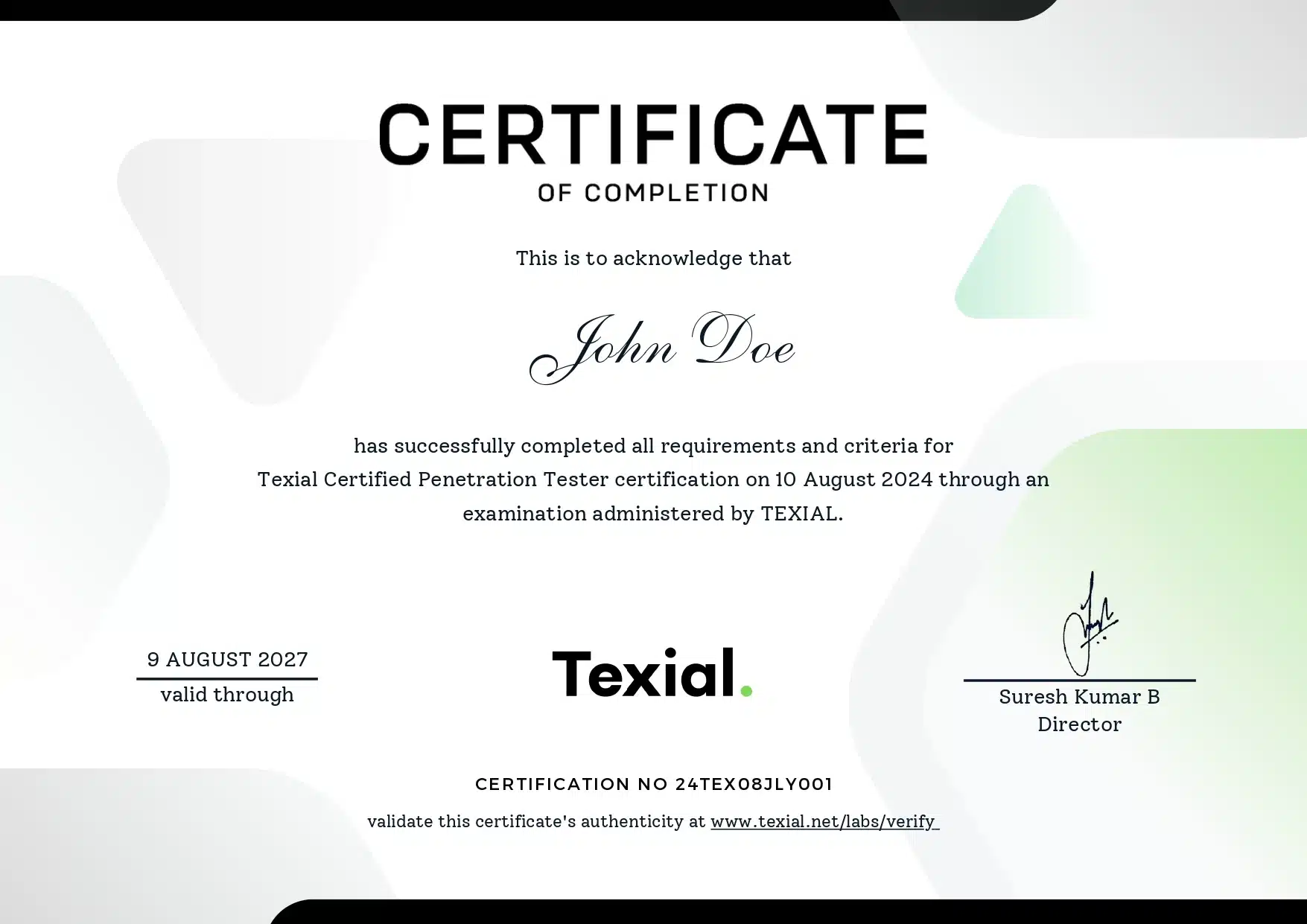
Master advanced enterprise exploitation with the Texial Certified Penetration Tester (TCPT) and EC-Council CPENT track. Built for offensive security specialists, this module trains you to chain multi-subnet pivots, escalate privileges across hardened Windows Active Directory and Linux environments, exploit APIs/JWTs, and write executive pentesting reports.
- Real-time attack & defense simulations
- Live sessions with cybersecurity experts
- Career-focused training & placement support
- Industry-aligned curriculum with Indian standards
600+ Offensive, SIEM & Digital Forensics Tools Covered














The Texial Advantage for Cyber Security Learners
Live doubt resolution, 1-on-1 project feedback, CTF workshops, and direct mentorship from practicing security auditors—every step of the way.
Practitioner Mentors
Train directly under active Red Team penetration testers, SOC Tier-3 leads, and digital forensic investigators.
360° Career Transformation
Guided progression from foundational networking to multi-domain VAPT, SOC, and DFIR workflows.
Live Doubt-Resolution Desk
Dedicated Q&A troubleshooting and mentor-moderated technical support.
1-on-1 Audit & Playbook Reviews
Detailed feedback on your VAPT closure reports, SIEM detection rules, and forensic documentation.
Red vs. Blue Cyber Range Drills
Live adversarial simulations, CTF tournaments, and CISO masterclasses.
Enterprise Interview Readiness
Mock SOC incident triage drills, live penetration testing defenses, and personalized career mapping.
6-Month Master Program Admission Process
Step 01
Submit Your Application Form
Step 02
1-on-1 Career Counseling & Track Selection (Pentesting or Forensics)
Step 03
Enrollment Confirmation & 24/7 Cloud Cyber Range Provisioning
Start Your Cyber Security Career Today
Transform into a multi-disciplinary cybersecurity professional in 6 months through 300 hours of live practitioner training, 600+ enterprise tools, and multi-certification readiness.
Program Structure & Inclusions
- 300 Hours (6 Months) of live instructor-led training (Classroom & Online)
- 4-Phase Master Syllabus covering Auditing, SOC, Forensics & Pentesting
- Dedicated internship, ATS resume optimization & 100% placement support
Reserve Batch Seat / Request Demo
Seat Inquiry Registered
Your batch details have been routed to the Texial Admissions Desk. Our counselor will reach out shortly, or you can open WhatsApp below.
Ethical Hacking (CEH v13 AI) — Upcoming Batches
Times shown in your local timezone


Cyber Security Course
You will gain a comprehensive, practical understanding of the four main areas of cyber security with our cyber security training. The training covers all of the pertinent material on Penetration Testing, Digital Forensics, SOC Operations, and Cyber security Course to ensure that you are ready for any real-world situation.
VAPT.
Ethical Hacking
- Information Gathering & Scanning
- Network & Web App Exploits
- Vulnerability Assessment
SOC Operations
- SIEM Tools (QRadar, Splunk)
- Threat Intelligence & Detection
- Log Monitoring, Incident Response
CHFI.
Digital Forensics
- Disk, Email & Memory Forensics
- Evidence Collection & Chain of Custody
- Forensic Reporting for Legal Cases
CPENT.
Penetration Testing
- Exploiting enterprise-grade systems
- Evading IDS/IPS
- Live Hack Lab simulations
Start Your Cyber security Career
Join the elite group of certified Cyber Security hackers and secure your future in the fastest-growing, highest-paying sector of the IT industry.
- Placement Assistance
- Global Certification
- High Salary Growth
- Remote Work Options
Dedicated Cybersecurity Placement Cell
Career Counselling
Personalized counseling to match your strengths with high-paying roles like Penetration Tester, VAPT Analyst, SOC Analyst, Incident Responder, or Digital Forensic Investigator.
Portfolio & Resume Engineering
Structured resume and technical portfolio optimization showcasing your multi-certification credentials, VAPT reports, and CTF rankings.
Supervised Cyber Internships
Verifiable industry experience through guided internships executing live vulnerability assessments and forensic investigations.
Global Enterprise Placement Drives
Direct interviews with hiring partners including KPMG, EY, PwC, ZeroFox, QSEAP, Bosch, Honeywell, Atos, Capgemini, Cognizant, and Bank of America.
Our Student Reviews

Vivek Gaonkar
Placed at QSEAP
Texial is a great place for beginners to know about cyber security, Had an awesome learning experience here. The Training and coaching staff are friendly and always there to clear our doubts.

Sahana S
Placed at Zerofox
The place where I gained confidence and knowledge in the field of cyber security. Trustworthy environment to get certified. I hope to see few more certifications.

Nikhil Vithal Ghorpade
Placed at Zerofox
The training was good. The trainers were helpful and friendly throughout the course. The learning experience was good, trainers made sure every concept was clearly understood.

Abhay RS
Placed at Zerofox
A very professional and great teaching with good practicals . And a very good choice to learn ethical hacking in Texial Cyber security even if you are from any stream . Good supportive teaching staffs for betterment of skills. Can have very good knowledge of basics of ethical hacking and there is no restrictions to learn. Happy and satisfied learning in Texial Cyber security

Shreyas N
Placed at QSEAP
I was lucky enough to get a highly supportive recruiter, helped me in identifying the right opportunities based on my background, briefed in detail about the interview procedures which made the whole process so smooth, also following up in a timely manner helped me with all the updates. Thanks to Team Texial, I was able to get a great offer. From my experience, I’d strongly recommend you to try and get certification from Texial Cyber Security .

Abhishek K K
Placed at Zerofox
Institution is very good, trainers are friendly. The teaching is fast and they also clear all the doubts. They support you until you get a job. Nice institution for freshers to learn about cyber security and Ethical hacking.

Viksha
Placed at KPMG
Good experience and great training center for cyber security. Can learn from scratch and delighted to score 124/125 in CEH v13 AI. Excellent and Happy learning in Texial Cyber security
Vivek Gaonkar
Placed at QSEAP
Texial is a great place for beginners to know about cyber security, Had an awesome learning experience here. The Training and coaching staff are friendly and always there to clear our doubts.
Sahana S
Placed at Zerofox
The place where I gained confidence and knowledge in the field of cyber security. Trustworthy environment to get certified. I hope to see few more certifications.
Nikhil Vithal Ghorpade
Placed at Zerofox
The training was good. The trainers were helpful and friendly throughout the course. The learning experience was good, trainers made sure every concept was clearly understood.
Abhay RS
Placed at Zerofox
A very professional and great teaching with good practicals . And a very good choice to learn ethical hacking in Texial Cyber security even if you are from any stream . Good supportive teaching staffs for betterment of skills. Can have very good knowledge of basics of ethical hacking and there is no restrictions to learn. Happy and satisfied learning in Texial Cyber security
Shreyas N
Placed at QSEAP
I was lucky enough to get a highly supportive recruiter, helped me in identifying the right opportunities based on my background, briefed in detail about the interview procedures which made the whole process so smooth, also following up in a timely manner helped me with all the updates. Thanks to Team Texial, I was able to get a great offer. From my experience, I’d strongly recommend you to try and get certification from Texial Cyber Security .
Abhishek K K
Placed at Zerofox
Institution is very good, trainers are friendly. The teaching is fast and they also clear all the doubts. They support you until you get a job. Nice institution for freshers to learn about cyber security and Ethical hacking.
Viksha
Placed at KPMG
Good experience and great training center for cyber security. Can learn from scratch and delighted to score 124/125 in CEH v13 AI. Excellent and Happy learning in Texial Cyber security
What is a Cyber Security Course, and what does Texial’s 6-month master syllabus cover?
A Cyber Security Course is a structured practitioner training program that teaches you how to protect enterprise networks, cloud infrastructure, web applications, and digital data from cyberattacks, unauthorized access, and data breaches. Texial’s flagship 6-Month (300-Hour) Cyber Security Master Program covers the complete enterprise security lifecycle across four integrated phases:
- Phase 1: Information Security Auditing & Ethical Hacking (TISA / CEH v13 AI)
- Phase 2: Defensive SOC & SIEM Operations (TCSA / CSA)
- Phase 3: Computer Hacking Forensic Investigation (TCFI / CHFI)
- Phase 4: Advanced Enterprise Penetration Testing (TCPT / CPENT).
What is the difference between a Cyber Security Course and a standalone Ethical Hacking Course?
Cyber Security is the overarching discipline of defending digital infrastructure across offensive, defensive, forensic, and compliance operations, whereas Ethical Hacking is a specialized 60-hour subset focused specifically on offensive vulnerability assessment and penetration testing. While our standalone Ethical Hacking course trains you primarily for Red Team auditing, our 6-Month Cyber Security Master Program (300 hours) trains you across Red Team (offensive exploitation), Blue Team (24/7 SIEM monitoring & incident response), Digital Forensics (DFIR), and Purple Team detection engineering—qualifying you for three times as many job roles.
Which 6-month specialization track should I choose: Penetration Testing (Red Team) or Digital Forensics (Blue Team & DFIR)
Both 6-month master tracks share the same core foundation in Ethical Hacking (TISA / CEH v13 AI) and SOC Analyst Operations (TCSA) during the first half of the program, allowing you to experience both offensive and defensive workflows before specializing. Choose the Master Program with Penetration Testing (TCPT / CPENT) if you enjoy breaking into hardened systems, exploiting APIs/JWTs, and performing Active Directory privilege escalation. Choose the Master Program with Digital Forensics (TCFI / CHFI) if you prefer investigating cybercrimes, reverse-engineering malware, analyzing memory/disk artifacts, and leading incident response.
How does a 6-month practitioner Cyber Security Certification compare to a 3–4 year B.Tech or B.Sc. degree?
A traditional 3-to-4-year college degree focuses heavily on broad computer science theory, academic mathematics, and legacy subjects, whereas Texial’s 6-Month (300-Hour) Cyber Security Master Program is a 70% hands-on technical accelerator built around the exact tools and frameworks (NIST, MITRE ATT&CK, OWASP) tested in enterprise technical interviews. Whether you pursue this program alongside your college degree, after graduation, or after 12th grade, it gives you verifiable cloud cyber range experience and accredited certifications in just 24 weeks.
Who is eligible for the Cyber Security Course? Can I join after 12th, graduation, or from a non-IT background?
Yes. Any individual with basic computer literacy and an analytical mindset can enroll—including 12th-pass students (Science, Commerce, or Arts), college undergraduates (B.E./B.Tech, BCA, MCA, B.Sc., B.Com, BBA), fresh graduates, and working professionals from non-IT or support backgrounds. Because Phase 1 of our syllabus starts from scratch with OSI/TCP-IP networking, hardware/OS fundamentals, and Linux command-line essentials, no prior cybersecurity work experience is required.
Is coding or advanced mathematics required to learn cyber security?
No. You do not need to be a software developer or know advanced calculus to succeed in cybersecurity. Over 80% of entry-to-mid-level roles in SOC Analysis, VAPT Auditing, Digital Forensics, and GRC Compliance rely on network logic, operating system architecture, log analysis, and security tools rather than software engineering. Where scripting is useful—such as reading Bash, Python, PowerShell, SQL queries, or KQL/SPL detection rules—our instructors teach you step-by-step from zero inside the lab.
Which certifications will I earn after completing the 6-Month Cyber Security Master Program?
Depending on your chosen track, you are prepared to earn up to three practitioner credentials from Texial alongside official globally accredited EC-Council certifications:
- Phase 1: Texial Information Security Auditor (TISA) & EC-Council Certified Ethical Hacker (CEH v13 AI)
- Phase 2: Texial Certified SOC Analyst (TCSA) & EC-Council Certified SOC Analyst (CSA)
- Phase 3 (Forensics Track): Texial Certified Forensic Investigator (TCFI) & Computer Hacking Forensic Investigator (CHFI)
- Phase 4 (Pentesting Track): Texial Certified Penetration Tester (TCPT) & Certified Penetration Testing Professional (CPENT)
Which cybersecurity tools and platforms will I master during the 300-hour Cloud Cyber Range labs?
You will gain hands-on command over 600+ offensive, defensive, and forensic utilities inside our 24/7 browser-accessible Cloud Cyber Range:
- Red Team & VAPT Tools: Kali Linux, Nmap, Burp Suite Pro, OWASP ZAP, Metasploit Framework, SQLmap, Nessus, OpenVAS, Hashcat, Aircrack-ng, Maltego, Wappalyzer, and ShellGPT/ReconAI.
- Blue Team, SIEM & EDR Tools: Splunk Enterprise, IBM QRadar, Microsoft Sentinel, Elastic Security (ELK Stack), Wireshark, Velociraptor, VirusTotal, Cisco Talos, IPVoid, YARA, and SIGMA rules.
- Digital Forensics (DFIR) Tools: Autopsy, The Sleuth Kit (TSK), Volatility Framework, FTK (Forensic Toolkit), Cellebrite UFED, MOBILedit, OSForensics, Amped FIVE, PhotoRec, and Hex Editors.
How is Artificial Intelligence (AI) integrated into this Cyber Security Course?
What is the duration and fee structure of the Cyber Security Course?
The complete Cyber Security Master Program runs for 6 months (300 hours of live instructor-led training plus 24/7 Cloud Cyber Range access). If you prefer a shorter, single-domain certification track (such as standalone Ethical Hacking or SOC Analyst), those tracks run for 60 hours (6 to 8 weeks) with fees starting from ₹25,000 to ₹45,000. For the 6-month 3-in-1 Master Programs (Pentesting Track or Digital Forensics Track), flexible installment plans and scholarship options are available through our Admissions Desk.
How are the online and offline classroom batches conducted, and do you offer weekend batches for working professionals?
We offer three flexible delivery modes: In-Person Classroom Training at our physical centers, 100% Live Interactive Virtual Classrooms accessible worldwide, and a Blended Hybrid Model. All classes are live, two-way instructor-led sessions (never pre-recorded video dumps), supported by 24/7 cloud lab access and recorded LMS backups for revision. We run dedicated weekday morning/evening cohorts as well as Saturday–Sunday weekend batches tailored for working IT professionals and full-time college students.
What laptop specifications are required to run the hands-on cybersecurity labs?
Because Texial hosts your multi-subnet target networks, SIEM servers, and forensic sandboxes inside our 24/7 browser-accessible Cloud Cyber Range, you do not need an expensive gaming rig. Any standard Windows, macOS, or Linux laptop with at least 8 GB RAM (16 GB recommended for local VMs), a quad-core processor (Intel i5 / AMD Ryzen 5 / Apple Silicon M-series), 60 GB of free disk space, and a stable broadband internet connection is sufficient.
What job roles can I apply for after completing the 6-Month Cyber Security Master Program?
Because you are trained across offensive, defensive, and forensic disciplines, you qualify for a wide spectrum of high-growth roles:
- Offensive / Red Team Roles: Penetration Tester, VAPT Analyst, Application/API Security Engineer, Red Team Operator, and Bug Bounty Researcher.
- Defensive / Blue Team Roles: Tier 1 & Tier 2 SOC Analyst, SIEM Engineer, Cyber Threat Intelligence (CTI) Analyst, Threat Hunter, and Incident Responder.
- Forensics & Governance Roles: Digital Forensic Investigator, Malware Analyst, DFIR Consultant, Information Security Auditor, and GRC Compliance Analyst.
What is the average salary of a Cyber Security professional in India and globally?
- In India: Freshers and entry-level analysts (SOC L1 / Junior VAPT Analyst) earn between ₹5.0 LPA and ₹9.0 LPA. Mid-level specialists (2–5 years of experience in Cloud Security, SIEM Engineering, CPENT Pentesting, or DFIR) earn ₹12.0 LPA to ₹24.0+ LPA.
- Globally (US, UK, UAE & Europe): Entry-to-mid-level Information Security Analysts, Penetration Testers, and SOC Engineers command between $85,000 and $135,000+ USD per year* (or AED 180,000 – AED 360,000+ in the UAE).
How does Texial’s internship and 100% placement assistance program work?
Every learner enrolled in our 6-Month Master Program receives end-to-end career acceleration through our Dedicated Placement Cell. This includes 1-on-1 career mapping, ATS-optimized resume and LinkedIn engineering, real-world VAPT/SOC/DFIR capstone internships, mock technical panel interviews, and direct placement drives with our network of 25+ hiring partners—including ZeroFox, KPMG, EY, PwC, Cognizant, Capgemini, Atos, Bosch, Honeywell, Standard Chartered, Bank of America, and QSEAP.
Where are Texial’s physical training centers located, and how can I book a free demo class?
Texial operates physical offline training campuses across Bangalore (Jayanagar), Hyderabad (Ameerpet), Pune (Shivajinagar), Kolkata (Salt Lake Sector V), Coimbatore (R.S. Puram), and Dubai, alongside live interactive online cohorts accessible from any country. You can reserve a free live demo session or speak 1-on-1 with a senior career counselor by clicking “Book a Demo” on this page, selecting a cohort in the Upcoming Batches calendar above, or calling/WhatsApping +91 98866 55699.
Contact Us
Texial Cyber Security Training Consultant
Looking to build your career in cyber security? Connect with Texial’s Cyber Security Consultants today – just give us a call and our experts will guide you.
