
Cyber Forensics Course | CHFI v11 & Digital Forensics Certification Training
Every cybercrime leaves a microscopic digital trail—if you know how to extract, reconstruct, and preserve it without corrupting the evidence. Texial’s Cyber Forensics Course equips you with the scientific methodology of Digital Forensics and Incident Response (DFIR). Powered by the ANSI-accredited EC-Council Computer Hacking Forensic Investigator (CHFI v11) curriculum and our hands-on Texial Certified Forensic Investigator (TCFI) track, this 60-hour (1.5-month) program trains you to investigate hard disks, volatile RAM, Windows/Linux/macOS endpoints, AWS/Azure cloud workloads, Dark Web (Tor) artifacts, malware droppers, and Android/iOS mobile devices inside a 24/7 browser-accessible Cloud Forensic Range.

Digital Forensics & Incident Response (DFIR) — Mastering CHFI v11 & Cybercrime Investigation
Texial’s 60-hour (1.5 months) Cyber Forensics & Digital Forensics Course awards dual credentials: EC-Council Computer Hacking Forensic Investigator (CHFI v11) and Texial Certified Forensic Investigator (TCFI). Participants master Autopsy, The Sleuth Kit (TSK), Volatility Framework, FTK, OpenText EnCase, Cellebrite UFED, MOBILedit, Wireshark, and Hex Editors via live examiner-led cohorts and a 24/7 Cloud Forensic Range. Tuition is INR 30,000 for the TCFI practical track or INR 45,000 for the all-inclusive dual certification track including the official EC-Council CHFI v11 exam voucher.
When an enterprise is struck by a destructive ransomware strain, an insider exfiltrates proprietary source code, or a financial institution suffers a multi-million-dollar wire fraud, one question dominates the boardroom and the courtroom: how did the breach happen, and can we prove it legally? Answering that question requires trained Digital Forensics and Incident Response (DFIR) examiners who can trace every modified registry hive, deleted partition, memory-resident payload, and network packet while maintaining an unbreakable Chain of Custody. Texial’s Cyber Forensics Certification Training prepares you to conduct legally defensible investigations aligned with ISO/IEC 27037, NIST SP 800-86, GDPR, PCI-DSS v4.0, CERT-In, and Section 63 of the Bharatiya Sakshya Adhiniyam (IT Act).
Inside Texial’s 24/7 browser-accessible Cloud Digital Forensics Laboratory, over 70% of your training is dedicated to investigating realistic cybercrime and enterprise breach evidence rather than memorizing static slides. Working alongside practicing forensic examiners, you will generate write-blocked bit-stream forensic images (dd, E01, AFF), verify MD5/SHA-256 hash integrity, carve wiped files from unallocated disk slack space across NTFS, FAT32, EXT4, and APFS file systems, and defeat anti-forensic steganography and trail obfuscation. You will dump and dissect volatile system RAM with Volatility, trace Tor Browser activity on the Dark Web, detonate fileless malware (Emotet) inside isolated sandboxes, and extract deleted communications from Android, iOS, IoT, and AWS/Azure cloud environments.
Graduating with both the ANSI-accredited EC-Council Computer Hacking Forensic Investigator (CHFI v11) and the Texial Certified Forensic Investigator (TCFI) credentials positions you at the top of technical hiring panels. Global Big 4 Forensic Advisory practices (Deloitte, PwC, EY, KPMG), enterprise CSIRTs, financial fraud units, and law enforcement cybercrime laboratories prioritize candidates who combine internationally recognized vendor certification with proven, hands-on evidence recovery and courtroom-grade forensic report writing.
Our delivery model is engineered for university graduates, SOC/IR analysts, law enforcement officers, and working IT professionals, offering immersive classroom cohorts alongside 100% live interactive online batches across global timezones. Cohorts are capped at 12–15 participants to ensure 1-on-1 assistance during complex hex carving and memory dump analysis. Every participant receives 6 months of HD recorded LMS access and 24/7 cloud lab availability for flexible revision across weekday or weekend schedules.
Core Skills Covered
- Execute forensically sound bit-stream data acquisition (dd, E01, AFF), hardware/software write-blocking, MD5/SHA-256 cryptographic hashing, and Chain-of-Custody documentation.
- Analyze hard disks, partitions (MBR/GPT), and file systems (NTFS, FAT32, EXT4, HFS+, APFS) using Autopsy, The Sleuth Kit (TSK), FTK, EnCase, and Hex Editors to carve wiped evidence.
- Conduct deep-dive Windows, Linux, and macOS endpoint forensics—extracting volatile RAM dumps (Volatility), Registry hives, ShellBags, LNK files, Jump Lists, browser history, and event logs.
- Defeat anti-forensics techniques including partition deletion, artifact wiping, steganography, trail obfuscation, file extension mismatches, program packers, and encrypted volumes.
- Investigate Network PCAPs, Web Server (IIS/Apache) attacks, Database (MSSQL/MySQL) breaches, Email phishing crimes, Dark Web (Tor) traces, and AWS/Azure/Container cloud incidents.
- Perform static and dynamic reverse-engineering of ransomware and fileless malware (Emotet) in isolated sandboxes alongside Android/iOS mobile and IoT extraction (Cellebrite UFED / MOBILedit).
Key Features
Texial Cyber Forensics & CHFI v11 Course Key Features
- 60 Hours (1.5 Months) of Live Examiner-Led Training (Classroom & Online)
- 100% Exam Pass Preparation & 1-on-1 Forensic Mentor Support
- 70% Hands-On Evidence Recovery in Simulated Cloud Forensic Labs
- Practical Mastery of Autopsy, Volatility, FTK, EnCase, UFED & MOBILedit
- Taught by Accredited DFIR Investigators & Cyber Law Specialists
- Full-Length EC-Council CHFI v11 (312-49) Mock Exams & TCFI Assessments
- Live Ransomware, Memory Dump, Dark Web, Cloud & Mobile Case Studies
- 24/7 Browser-Accessible Cloud Forensic Range & Malware Sandboxes
- Dedicated DFIR Placement Cell, Case Portfolio & Mock Interviews
- Globally Recognized Dual Certification Track (EC-Council CHFI v11 + TCFI)
Eligibility and Pre-requisites
- Zero Prior Forensics or Coding Experience Required: Because our 16-module curriculum builds step-by-step from disk geometry, OS boot sequences, and binary/hex fundamentals, beginners can enroll directly.
- B.Tech, BCA, MCA & B.Sc./M.Sc. Forensic Science Students: Computer science graduates and traditional forensic science or criminology learners seeking high-growth entry into corporate DFIR and cybercrime labs.
- SOC Analysts, Incident Responders & Penetration Testers: L1/L2 SOC analysts, system administrators, and VAPT specialists upgrading into Tier-3 post-breach forensics and malware analysis.
- Law Enforcement, Cyber Lawyers & Fraud Auditors: Police cyber-cell officers, LL.B. professionals, Chartered Accountants, and e-Discovery specialists handling electronic evidence and corporate fraud.
Our Training Formats
- Instructor-Led In-Person DFIR Batches & Lab Bootcamps
Direct Evidence Acquisition Mentorship & Case Reconstruction
Live Examiner-Led Classes + 6-Month Recorded HD LMS Access
Flexible Weekday & Weekend Schedules for Students and Working Pros
100% Live Two-Way Interactive Online Sessions Accessible Worldwide
- Real-Time 1-on-1 Mentorship & 24/7 Browser-Based Cloud Forensic Range
- Global Cohort Schedules Across IST, EST, GMT & GST Timezones
Cyber Forensics & CHFI v11 Course Curriculum (16-Module Dual-Track Syllabus)
Structured around the complete lifecycle of a professional cybercrime and enterprise breach investigation—from first-responder evidence seizure to courtroom testimony—our 16-module dual-track syllabus leaves no digital artifact unexamined. Tab 1 covers the official EC-Council Computer Hacking Forensic Investigator (CHFI v11) curriculum, while Tab 2 delivers our hands-on Texial Certified Forensic Investigator (TCFI) practitioner track—adding intensive raw hex carving, Volatility memory hunting, electronic evidence law, and executive forensic closure reporting.
Practical Lab 01: Bit-Stream Disk Imaging, File Carving & Anti-Forensics Recovery
dd) and Expert Witness (E01) disk images, verify SHA-256 hash integrity, parse NTFS MFT and EXT4 journals, recover intentionally deleted partitions, detect steganography and mismatched file headers, and carve wiped files from unallocated slack space.
Practical Lab 02: Windows, Linux, macOS & Volatile Memory (RAM) Forensics
pslist, pstree, malfind, netscan) to uncover rogue processes, DLL injection, and C2 sockets, and reconstruct user activity across Windows Registry hives (SAM/SYSTEM/NTUSER.DAT), Prefetch, ShellBags, LNK files, Jump Lists, and Linux/macOS logs.
Practical Lab 03: Static/Dynamic Malware, Dark Web (Tor) & Web/Email Crime Forensics
Practical Lab 04: Cloud (AWS/Azure), Database & Mobile/IoT Device Extraction
Module 01: Computer Forensics in Today’s World
- Understand the Fundamentals of Computer Forensics
- Understand Cybercrimes and their Investigation Procedures
- Understand Digital Evidence
- Understand Forensic Readiness, Incident Response and the Role of SOC (Security Operations Center) in Computer Forensics
- Identify the Roles and Responsibilities of a Forensic Investigator
- Understand the Challenges Faced in Investigating Cybercrimes
Module 02: Computer Forensics Investigation Process
- Understand the Forensic Investigation Process and its Importance
- Understand the Pre-investigation Phase
- Understand First Response
- Understand the Investigation Phase
- Understand the Post-investigation Phase
Module 03: Understanding Hard Disks and File Systems
- Describe Different Types of Disk Drives and their Characteristics
- Explain the Logical Structure of a Disk
- Understand Booting Process of Windows, Linux and Mac Operating Systems
- Understand Various File Systems of Windows, Linux and Mac Operating Systems
- Examine File System Using Autopsy and The Sleuth Kit Tools
- Understand Storage Systems
- Understand Encoding Standards and Hex Editors
- Analyze Popular File Formats Using Hex Editor
Module 04: Data Acquisition and Duplication
- Understand Data Acquisition Fundamentals
- Understand Data Acquisition Methodology
- Prepare an Image File for Examination
Module 05: Defeating Anti-Forensics Techniques
- Understand Anti-forensics Techniques
- Discuss Data Deletion and Recycle Bin Forensics
- Illustrate File Carving Techniques and Ways to Recover Evidence from Deleted Partitions
- Explore Password Cracking/Bypassing Techniques
- Detect Steganography, Hidden Data in File System Structures, Trail Obfuscation, and File Extension Mismatch
- Understand Techniques of Artifact Wiping, Overwritten Data/Metadata Detection, and Encryption
- Detect Program Packers and Footprint Minimizing Techniques
- Understand Anti-forensics Countermeasures
Module 06: Windows Forensics
- Collect Volatile and Non-volatile Information
- Perform Windows Memory and Registry Analysis
- Examine the Cache, Cookie and History Recorded in Web Browsers
- Examine Windows Files and Metadata
- Understand ShellBags, LNK Files, and Jump Lists
- Understand Text-based Logs and Windows Event Logs
Module 07: Linux and Mac Forensics
- Understand Volatile and Non-volatile Data in Linux
- Analyze Filesystem Images Using The Sleuth Kit
- Demonstrate Memory Forensics Using Volatility & PhotoRec
- Understand Mac Forensics
Module 08: Network Forensics
- Understand Network Forensics
- Explain Logging Fundamentals and Network Forensic Readiness
- Summarize Event Correlation Concepts
- Identify Indicators of Compromise (IoCs) from Network Logs
- Investigate Network Traffic
- Perform Incident Detection and Examination with SIEM Tools
- Monitor and Detect Wireless Network Attacks
Module 09: Investigating Web Attacks
- Understand Web Application Forensics
- Understand Internet Information Services (IIS) Logs
- Understand Apache Web Server Logs
- Understand the Functionality of Intrusion Detection System (IDS)
- Understand the Functionality of Web Application Firewall (WAF)
- Investigate Web Attacks on Windows-based Servers
- Detect and Investigate Various Attacks on Web Applications
Module 10: Dark Web Forensics
- Understand the Dark Web
- Determine How to Identify the Traces of Tor Browser during Investigation
- Perform Tor Browser Forensics
Module 11: Database Forensics
- Understand Database Forensics and its Importance
- Determine Data Storage and Database Evidence Repositories in MSSQL Server
- Collect Evidence Files on MSSQL Server
- Perform MSSQL Forensics
- Understand Internal Architecture of MySQL and Structure of Data Directory
- Understand Information Schema and List MySQL Utilities for Performing Forensic Analysis
- Perform MySQL Forensics on WordPress Web Application Database
Module 12: Cloud Forensics
- Understand the Basic Cloud Computing Concepts
- Understand Cloud Forensics
- Understand the Fundamentals of Amazon Web Services (AWS)
- Determine How to Investigate Security Incidents in AWS
- Understand the Fundamentals of Microsoft Azure
- Determine How to Investigate Security Incidents in Azure
- Understand Forensic Methodologies for Containers and Microservices
Module 13: Investigating Email Crimes
- Understand Email Basics
- Understand Email Crime Investigation and its Steps
- U.S. Laws Against Email Crime
Module 14: Malware Forensics
- Define Malware and Identify the Common Techniques Attackers Use to Spread Malware
- Understand Malware Forensics Fundamentals and Recognize Types of Malware Analysis
- Understand and Perform Static Analysis of Malware
- Analyze Suspicious Word and PDF Documents
- Understand Dynamic Malware Analysis Fundamentals and Approaches
- Analyze Malware Behavior on System Properties in Real-time
- Analyze Malware Behavior on Network in Real-time
- Describe Fileless Malware Attacks and How they Happen
- Perform Fileless Malware Analysis – Emotet
Module 15: Mobile Forensics
- Understand the Importance of Mobile Device Forensics
- Illustrate Architectural Layers and Boot Processes of Android and iOS Devices
- Explain the Steps Involved in Mobile Forensics Process
- Investigate Cellular Network Data
- Understand SIM File System and its Data Acquisition Method
- Illustrate Phone Locks and Discuss Rooting of Android and Jailbreaking of iOS Devices
- Perform Logical Acquisition on Android and iOS Devices
- Perform Physical Acquisition on Android and iOS Devices
- Discuss Mobile Forensics Challenges and Prepare Investigation Report
Module 16: IoT Forensics
- Understand IoT and IoT Security Problems
- Recognize Different Types of IoT Threats
- Understand IoT Forensics
- Perform Forensics on IoT Devices
Cyber Forensics & CHFI v11 Certification Training Options
INR 30,000
- Complete 60 Hours (1.5 Months) interactive training (Classroom or Live Online)
- 24/7 browser access to Texial’s simulated Cloud Cyber Forensic Range
- Live disk imaging, RAM analysis & malware forensics demos by certified examiners
- Practical training across all 16 CHFI v11 & TCFI modules and forensic tools
- Small cohort sizes (12–15 learners) for 1-on-1 artifact recovery support
- Includes Texial Certified Forensic Investigator (TCFI) practical exam & certificate
INR 45,000
- Official ANSI-Accredited EC-Council CHFI v11 Exam Voucher & Coursewarearning delivery model (instructor-led and self-paced e-learning notes
- Blended delivery model (Live examiner-led classes + 6-month recorded LMS)
- 6 months access to official EC-Council study material and cloud forensic labs
- Dedicated learner community and 1-on-1 mentor doubt-resolution forum
- Live cybercrime investigation case studies and DFIR Cyber Range challenges
- Flexible weekday and weekend batches backed by 100% placement support
Customized to Your Organization’s Security Needs
- Bespoke DFIR curriculum tailored for corporate CSIRTs, advisories, or cyber cells
- Custom ransomware root-cause, AWS/Azure cloud breach, and mobile extraction labs
- Forensic readiness & compliance alignment for ISO/IEC 27037, GDPR & CERT-In
- Group corporate bootcamp pricing for on-site or live virtual global cohorts
- Examiner skill benchmarking, case-resolution tracking, and executive reporting
- Post-training advisory on forensic lab setup and chain-of-custody SOPs
Earn Your EC-Council CHFI v11 and Texial Certified Forensic Investigator (TCFI) Credentials
Hiring managers in Big 4 Forensic Advisory practices, corporate incident response teams, and government cybercrime units demand both internationally accredited vendor certification and verifiable lab competence. Through our simulated cloud forensic labs, you will master both multi-platform evidence recovery and court-admissible forensic reporting.
Our dual certification pathway prepares you to earn two high-value industry credentials:
- Texial Certified Forensic Investigator (TCFI) — Practical Disk, Memory, Malware & Mobile Forensics Credential
- EC-Council Computer Hacking Forensic Investigator (CHFI v11) — Globally Accredited ANSI Vendor Credential
Computer Hacking Forensic Investigator — EC-Council CHFI v11
Accredited by ANSI and mapped to global NICE and DoD 8570/8140 frameworks, the EC-Council Computer Hacking Forensic Investigator (CHFI v11) certification validates your ability to seize electronic evidence, reconstruct complex cyberattacks across 16 forensic domains, and conduct legally defensible audits.
- Globally Recognized ANSI-Accredited DFIR Certification
- Official Courseware & Forensic Lab Kit by EC-Council
- EC-Council Computer Hacking Forensic Investigator (CHFI v11 — Exam 312-49)
- Expert Exam Prep & Forensic Case Discussion Panel
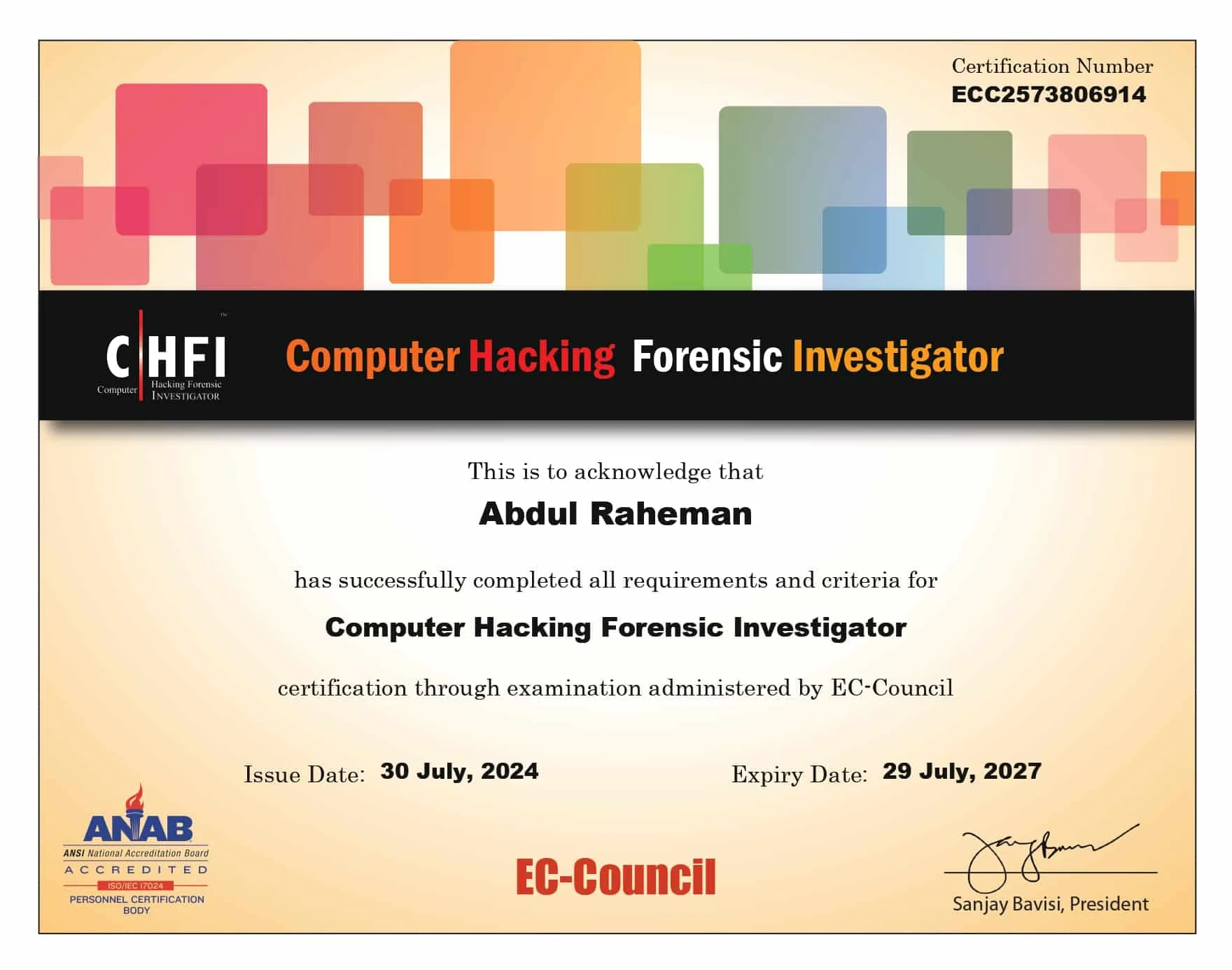
Texial Certified Forensic Investigator
The Texial Certified Forensic Investigator (TCFI) and EC-Council CHFI track equips digital forensic examiners and incident responders with the technical methodology to seize, preserve, and analyze digital evidence across Windows, Linux, macOS, volatile memory, network traffic, cloud workloads, and mobile devices.
- Globally Recognized DFIR & Cyber Crime Investigation Track
- Hands-On Disk, Memory, Network, Cloud & Mobile Forensics Labs
- Prepares You for Texial TCFI & EC-Council CHFI Credentials
- Chain-of-Custody Documentation & Forensic Report Writing
Enterprise Digital Forensics, Memory & Mobile Extraction Tools Covered





The Texial Advantage for Cyber Forensics Learners
Live hex-carving assistance, 1-on-1 forensic report critiques, malware sandbox workshops, and direct mentorship from practicing DFIR examiners—every step of the way.
Practicing DFIR Mentors
Learn directly from active digital forensic investigators, malware analysts, and incident response leads. Gain real-world insights into disk imaging, memory analysis, ransomware triage, and chain-of-custody protocols.
Multi-Platform Evidence Labs
With continuous 1-on-1 mentoring and 70% practical cloud forensic execution across Windows, Linux, macOS, RAM, AWS/Azure, Dark Web, and mobile images, you graduate interview-ready.
Live Q&A & 6-Month LMS
Dedicated doubt-clarification segments at the end of every live class, backed by 6 months of HD recorded LMS access and a mentor-moderated DFIR community.
1-on-1 Forensic Report Reviews
Receive personalized mentor feedback on your disk acquisition hash logs, Volatility memory timelines, malware sandbox findings, and court-style forensic closure reports.
Breach Reconstruction Workshops
Participate in hands-on breach investigation clinics, cyber law seminars, and Capture the Flag (CTF) forensic challenges using Autopsy, Volatility, and Wireshark
DFIR Technical Panel Prep
Engage in mock Big 4 advisory and CSIRT technical interviews, live artifact-identification drills, and 1-on-1 career mapping sessions.
Reserve Batch Seat / Request Demo
Seat Inquiry Registered
Your batch details have been routed to the Texial Admissions Desk. Our counselor will reach out shortly, or you can open WhatsApp below.
Ethical Hacking (CEH v13 AI) — Upcoming Batches
Times shown in your local timezoneProgram Fee: ₹45,000 (Dual Certification Track)
Step 01
Submit Your Cohort Application or Request a 1-on-1 Forensic Lab Demo
Step 02
1-on-1 Career Counseling & Batch Slot Selection (Weekday or Weekend)
Step 03
Instant 24/7 Cloud Forensic Range & LMS Provisioning
Start Learning Today
Launch your Digital Forensics and Incident Response (DFIR) career today by mastering enterprise forensic tools, investigating simulated cybercrimes, and earning dual certifications recognized by Big 4 advisories, CSIRTs, and law enforcement agencies.
Course Structure & Inclusions
- 60 Hours (1.5 Months) of live examiner-led CHFI v11 & TCFI training + 6-month recorded LMS
- Career counseling, ATS resume engineering, and 100% placement assistance
- 24/7 browser-based Cloud Forensic Range labs and real-world breach simulations
Dedicated Digital Forensics & DFIR Placement Cell
Career Counselling
Map your analytical strengths with 1-on-1 guidance from our career advisors to target high-growth openings in Digital Forensics, Incident Response (DFIR), Malware Analysis, and e-Discovery.
Resume Optimization
Our hiring specialists engineer your ATS resume and LinkedIn profile to highlight your EC-Council CHFI v11 and Texial TCFI credentials, Autopsy/Volatility/UFED skills, and forensic case portfolio.
Forensic Case Portfolio & Internships
Graduate with a verifiable portfolio of disk acquisition reports, RAM dump timelines, and malware analysis findings valued by Big 4 advisories and enterprise CSIRTs.
Enterprise Interview Prep & Drives
Interview directly with our network of 25+ global hiring partners—including KPMG, EY, PwC, ZeroFox, Cognizant, Capgemini, Atos, Bosch, Honeywell, Standard Chartered, Bank of America, and QSEAP.
Our Placement Partners
Our Student Reviews

Vivek Gaonkar
Placed at QSEAP
Texial is a great place for beginners to know about cyber security, Had an awesome learning experience here. The Training and coaching staff are friendly and always there to clear our doubts.

Sahana S
Placed at Zerofox
The place where I gained confidence and knowledge in the field of cyber security. Trustworthy environment to get certified. I hope to see few more certifications.

Nikhil Vithal Ghorpade
Placed at Zerofox
The training was good. The trainers were helpful and friendly throughout the course. The learning experience was good, trainers made sure every concept was clearly understood.

Abhay RS
Placed at Zerofox
A very professional and great teaching with good practicals . And a very good choice to learn ethical hacking in Texial Cyber security even if you are from any stream . Good supportive teaching staffs for betterment of skills. Can have very good knowledge of basics of ethical hacking and there is no restrictions to learn. Happy and satisfied learning in Texial Cyber security

Shreyas N
Placed at QSEAP
I was lucky enough to get a highly supportive recruiter, helped me in identifying the right opportunities based on my background, briefed in detail about the interview procedures which made the whole process so smooth, also following up in a timely manner helped me with all the updates. Thanks to Team Texial, I was able to get a great offer. From my experience, I’d strongly recommend you to try and get certification from Texial Cyber Security .

Abhishek K K
Placed at Zerofox
Institution is very good, trainers are friendly. The teaching is fast and they also clear all the doubts. They support you until you get a job. Nice institution for freshers to learn about cyber security and Ethical hacking.

Viksha
Placed at KPMG
Good experience and great training center for cyber security. Can learn from scratch and delighted to score 124/125 in CEH v13 AI. Excellent and Happy learning in Texial Cyber security
Vivek Gaonkar
Placed at QSEAP
Texial is a great place for beginners to know about cyber security, Had an awesome learning experience here. The Training and coaching staff are friendly and always there to clear our doubts.
Sahana S
Placed at Zerofox
The place where I gained confidence and knowledge in the field of cyber security. Trustworthy environment to get certified. I hope to see few more certifications.
Nikhil Vithal Ghorpade
Placed at Zerofox
The training was good. The trainers were helpful and friendly throughout the course. The learning experience was good, trainers made sure every concept was clearly understood.
Abhay RS
Placed at Zerofox
A very professional and great teaching with good practicals . And a very good choice to learn ethical hacking in Texial Cyber security even if you are from any stream . Good supportive teaching staffs for betterment of skills. Can have very good knowledge of basics of ethical hacking and there is no restrictions to learn. Happy and satisfied learning in Texial Cyber security
Shreyas N
Placed at QSEAP
I was lucky enough to get a highly supportive recruiter, helped me in identifying the right opportunities based on my background, briefed in detail about the interview procedures which made the whole process so smooth, also following up in a timely manner helped me with all the updates. Thanks to Team Texial, I was able to get a great offer. From my experience, I’d strongly recommend you to try and get certification from Texial Cyber Security .
Abhishek K K
Placed at Zerofox
Institution is very good, trainers are friendly. The teaching is fast and they also clear all the doubts. They support you until you get a job. Nice institution for freshers to learn about cyber security and Ethical hacking.
Viksha
Placed at KPMG
Good experience and great training center for cyber security. Can learn from scratch and delighted to score 124/125 in CEH v13 AI. Excellent and Happy learning in Texial Cyber security
Texial Cyber Forensics Advisory Board



Cyber Forensics & CHFI v11 Course — Frequently Asked Questions (FAQs)
What is a Cyber Forensics (Digital Forensics) Course, and what does a Computer Hacking Forensic Investigator do?
A Cyber Forensics Course (also known as Digital Forensics and Incident Response / DFIR training) teaches you the scientific and legal methodology of identifying, seizing, preserving, extracting, and analyzing digital evidence from computers, servers, networks, cloud platforms, and smartphones following a cybercrime or enterprise data breach. A Computer Hacking Forensic Investigator (CHFI) acts as a digital detective—reconstructing how hackers breached a system, recovering intentionally deleted or encrypted files, analyzing volatile RAM and malware payloads, maintaining a tamper-proof Chain of Custody, and preparing forensic investigation reports that are admissible in a court of law or corporate tribunal.
What is the difference between Cyber Forensics (DFIR), Ethical Hacking (Red Team), and SOC Analysis (Blue Team)?
Each discipline plays a distinct role in the enterprise cybersecurity lifecycle:
- Ethical Hacking / Penetration Testing (Red Team — Proactive Offensive): Simulates cyberattacks before a breach occurs to find and patch vulnerabilities across networks, web apps, and APIs.
- SOC Analysis (Blue Team — Real-Time Monitoring): Continuously monitors SIEM and EDR telemetry 24/7 to detect anomalies, triage alerts, and block incoming attacks in real time.
- Cyber Forensics / DFIR (Post-Breach Investigation & Root-Cause Recovery): Steps in during and after a major security incident, ransomware attack, insider theft, or cybercrime to perform deep-dive disk, memory, network, cloud, and malware forensics—determining the exact root cause, scope of data exfiltration, and legal attribution.
What is the EC-Council CHFI v11 certification, and how does Texial’s Dual Certification (CHFI v11 + TCFI) benefit my career?
The EC-Council Computer Hacking Forensic Investigator (CHFI v11) is the world’s premier vendor-neutral, ANSI-accredited digital forensics certification, recognized by global law enforcement agencies, defense organizations, Big 4 accounting/advisory firms, and Fortune 500 incident response teams. When you enroll at Texial, you prepare for two credentials simultaneously:
- EC-Council CHFI v11: Validates your global vendor accreditation across 16 comprehensive forensic domains to pass enterprise HR and ATS filters worldwide.
- Texial Certified Forensic Investigator (TCFI): Validates your hands-on practitioner ability to acquire bit-stream disk images, analyze live memory dumps, reverse-engineer malware, and write legally compliant forensic closure reports inside a real-time cyber range.
Which digital forensics, memory analysis, and mobile extraction tools will I master during the 60-hour lab training?
Over 70% of your training takes place inside Texial’s 24/7 Cloud Cyber Forensic Range, where you work hands-on with industry-standard commercial and open-source forensic suites:
- Disk, File System & e-Discovery Suites: Autopsy, The Sleuth Kit (TSK), FTK (Forensic Toolkit) & FTK Imager, OpenText EnCase, OSForensics, PhotoRec, and Raw Hex Editors (WinHex / HxD).
- Volatile Memory (RAM) & Endpoint Forensics: Volatility Framework, DumpIt, Registry Explorer, ShellBags Explorer, PECmd, and Sysinternals Suite.
- Mobile, SIM & IoT Forensics: Cellebrite UFED workflows, MOBILedit Forensic, GrayKey concepts, Android ADB extraction, iOS Plist/SQLite analyzers, and Amped FIVE.
- Network, Malware & Dark Web Forensics: Wireshark, Tcpdump, NetworkMiner, Tor Browser Forensics, PEStudio, Process Monitor, YARA rules, and isolated Malware Sandboxes.
Do I need prior coding, programming, or cybersecurity experience to learn Cyber Forensics?
No. You do not need to be a software developer or have prior cybersecurity work experience to enroll in our Cyber Forensics Course. Digital forensics relies on methodical investigation, file system logic, operating system artifact analysis, and specialized forensic software rather than writing application code. Our 16-module curriculum starts from the ground up—teaching you hard disk architecture, boot sequences, NTFS/EXT4/APFS file systems, binary/hexadecimal encoding, and Windows/Linux OS internals before progressing to advanced memory, cloud, and malware forensics.
Who is eligible for this course? Can B.Sc. Forensic Science, B.Tech, BCA, Law/Criminology students, or non-IT graduates join?
Yes. Any student, fresh graduate, or working professional with basic computer knowledge can enroll. This program is ideal for:
- Engineering & IT Students/Graduates: B.E./B.Tech, BCA, MCA, and B.Sc. (CS/IT) learners targeting DFIR and Incident Response careers.
- B.Sc. / M.Sc. Forensic Science & Criminology Graduates: Traditional forensic science students transitioning into high-paying corporate and law-enforcement Digital & Cyber Forensics roles.
- Law Graduates, Auditors & Fraud Examiners: LL.B. graduates, cyber lawyers, Chartered Accountants (CA), and CFE professionals specializing in cyber law, e-Discovery, and financial fraud investigation.
- Working IT, SOC & Police Cyber-Cell Personnel: SOC L1/L2 analysts, system administrators, and law enforcement officers upgrading their technical investigation capabilities.
What is the examination format, duration, and validity of the EC-Council CHFI v11 and Texial TCFI exams?
Because this is a dual-certification program, two separate assessments validate your mastery:
- EC-Council CHFI v11 Exam (Exam Code 312-49): A 4-hour proctored examination consisting of 150 multiple-choice questions testing your knowledge across all 16 digital forensics domains (passing score ranges from 60% to 85% depending on exam form difficulty). The CHFI v11 credential is valid for 3 years under EC-Council’s Continuing Education (ECE) policy.
- Texial Certified Forensic Investigator (TCFI) Exam: A 4-hour hands-on practical examination inside Texial’s Cloud Cyber Range where you examine compromised disk and memory images, recover hidden/deleted evidence, and submit a formal Forensic Investigation Report.
What is the fee structure and duration of Texial’s Cyber Forensics Course?
The complete Cyber Forensics training program runs for 60 hours (approximately 6 to 8 weeks on weekdays or 8 to 10 weeks via weekend batches). We offer two transparent enrollment tracks:
- Option 1 — Texial Certified Forensic Investigator (TCFI) Track (₹30,000): Includes all 60 hours of live instructor-led training (Classroom or Online), 24/7 Cloud Forensic Range access, hands-on labs across all 16 modules, and the TCFI practical exam and certificate.
- Option 2 — All-Inclusive Dual Certification Track: EC-Council CHFI v11 + TCFI (₹45,000): Includes everything in Option 1 plus your official EC-Council CHFI v11 exam voucher, 6 months of official EC-Council e-courseware and iLabs access, CTF exercises, and 100% placement support.
What is the difference between Disk Forensics and Volatile Memory (RAM) Forensics, and does this course cover both?
Yes, both are core pillars of our syllabus:
- Disk (Non-Volatile) Forensics (Modules 03–07): Focuses on persistent storage media (SSDs, HDDs, USB drives). You learn to perform write-blocked bit-stream imaging, analyze Master File Tables ($MFT), recover deleted partitions, carve wiped files from unallocated clusters, and inspect OS registry hives and logs.
- Volatile Memory (RAM) Forensics (Modules 06, 07 & 14): Modern ransomware and fileless malware (such as Emotet or Cobalt Strike beacons) execute directly inside system RAM without leaving files on the hard drive. Using the Volatility Framework, you learn to capture and analyze live RAM dumps to uncover hidden processes, injected DLLs, active network sockets, command histories, and encryption keys before a machine is powered off.
Will I learn Mobile Device Forensics (Android & iOS), Dark Web (Tor) Investigation, and Cloud Forensics (AWS & Azure)?
Yes. Unlike outdated computer-only forensics courses, CHFI v11 and TCFI train you across modern distributed environments:
- Mobile & IoT Forensics (Modules 15 & 16): Covers Android and iOS architecture, boot processes, screen-lock bypassing, rooting/jailbreaking concepts, SIM file systems, cellular CDR analysis, and logical/physical data extraction using Cellebrite UFED and MOBILedit.
- Dark Web Forensics (Module 10): Teaches you how to detect and reconstruct Tor Browser artifacts from disk and volatile memory to trace illicit Dark Web communications.
- Cloud & Container Forensics (Module 12): Trains you to investigate security breaches across Amazon Web Services (AWS), Microsoft Azure, Docker containers, and microservices without violating multi-tenant cloud integrity.
How does Malware Forensics work in this course, and will I analyze real ransomware and fileless malware?
In Module 14 (Malware Forensics), you learn both Static Malware Analysis (inspecting PE headers, file hashes, embedded strings, packed binaries, and malicious Word/PDF macros without executing the file) and Dynamic Malware Analysis (detonating ransomware, trojans, and fileless malware like Emotet inside an isolated sandbox to monitor real-time process creation, registry modifications, and Command-and-Control network traffic).
Does the course cover Chain of Custody, Anti-Forensics Countermeasures, and Cyber Law / Electronic Evidence Admissibility?
Yes. Digital evidence is useless in court or corporate litigation if its integrity can be challenged. You will learn how to defeat anti-forensics techniques (data wiping, steganography, trail obfuscation, encryption, and packers) while maintaining a legally defensible Chain of Custody using cryptographic hashes (MD5, SHA-1, SHA-256). We also cover global and Indian cyber law standards—including ISO/IEC 27037, US Federal Rules of Evidence, GDPR, the Indian IT Act 2000, and Electronic Evidence Admissibility Certificates (Section 63 of the Bharatiya Sakshya Adhiniyam / erstwhile Section 65B of the Indian Evidence Act).
What job roles and career paths can I apply for after completing the Cyber Forensics (CHFI v11 & TCFI) Course?
Graduating with dual CHFI v11 and TCFI credentials qualifies you for high-impact roles across private enterprises, consulting firms, financial institutions, and government agencies:
- Digital Forensic Investigator / Computer Forensic Examiner
- DFIR (Digital Forensics & Incident Response) Consultant
- CSIRT / Tier-2 & Tier-3 Incident Response Analyst
- Malware Forensics Analyst & Reverse Engineer
- Mobile & Cloud Forensics Specialist
- e-Discovery & Forensic Accounting Analyst (Big 4 Advisory)
- Law Enforcement Cybercrime Investigator & Forensic Lab Examiner
What is the average salary of a Cyber Forensics & DFIR Investigator in India, the US, the UK, and the UAE?
Because qualified DFIR specialists are scarce and handle high-stakes corporate breaches and legal investigations, compensation is among the highest in cybersecurity:
In India: Entry-level Digital Forensic Analysts and Junior DFIR Associates earn between ₹5.5 LPA and ₹9.5 LPA. Mid-level DFIR Consultants, Incident Responders, and Malware Analysts (2–5 years of experience) earn ₹12.0 LPA to ₹22.0 LPA, while Senior DFIR Leads and Forensic Managers command ₹25.0 LPA to ₹40.0+ LPA.
- In the United States: Certified Forensic Investigators and DFIR Consultants earn between $95,000 and 145,000USDperyear,withPrincipalDFIRArchitectsexceeding175,000+ USD.
- In the UK & Europe: Compensation ranges from £50,000 to £95,000+ GBP (€60,000 – €110,000+ EUR).
- In the UAE & Middle East (Dubai / Riyadh): Tax-free salaries for Digital Forensic Examiners range from AED 180,000 to AED 340,000+ per year.
Which industries and companies hire CHFI v11 and TCFI certified professionals?
Digital forensic specialists are actively recruited by:
- Big 4 & Global Risk Advisories: Deloitte, PwC, EY, KPMG, Kroll, Mandiant, and CrowdStrike Incident Response teams.
- Banking, FinTech & Insurance (BFSI): Global banks, payment processors, and cyber-insurance underwriters investigating wire fraud and ransomware claims.
- Managed Security Service Providers (MSSPs) & Tech Enterprises: ZeroFox, Atos, Capgemini, Cognizant, Check Point, Bosch, Honeywell, and QSEAP.
- Law Enforcement, Defense & Government Agencies: State and federal cybercrime cells, forensic science laboratories (FSLs), defense intelligence units, and regulatory bodies.
How are the hands-on forensic labs conducted, and what laptop specifications do I need?
All 16 modules of forensic investigation—including disk image mounting, file carving, RAM dump analysis, and malware sandboxing—run inside Texial’s 24/7 browser-accessible Cloud Cyber Range. Because our cloud servers handle the heavy processing and storage of multi-gigabyte forensic disk images and virtual machines, any standard Windows, macOS, or Linux laptop with 8 GB RAM (16 GB recommended for local VMs), a quad-core processor (Intel i5 / AMD Ryzen 5 / Apple Silicon), and a stable broadband internet connection is sufficient.
Are live online, weekday, and weekend batches available for working professionals and college students?
Yes. We offer In-Person Classroom Training at our physical centers, 100% Live Interactive Virtual Classrooms accessible worldwide, and a Blended Hybrid Model. All classes are live, instructor-led sessions (never pre-recorded video dumps), supported by 6 months of HD recorded LMS access and 24/7 cloud lab availability. We run dedicated weekday morning/evening batches as well as Saturday–Sunday weekend cohorts designed for working professionals and full-time university students.
Where are Texial’s physical training centers located, and how can I book a free live Cyber Forensics demo class?
Texial operates physical offline training campuses in Bangalore (Jayanagar), Hyderabad (Ameerpet), Pune (Shivajinagar), Kolkata (Salt Lake Sector V), Coimbatore (R.S. Puram), and Dubai, alongside live interactive online cohorts accessible from any country. You can book a free 1-on-1 live Cyber Forensics lab demo and career counseling session by clicking “Book a Demo” on this page, selecting a cohort in the Upcoming Batches calendar above, or calling/WhatsApping our Admissions Desk at +91 98866 55699.
EC-Council Accredited Computer Hacking Forensic Investigator (CHFI v11) Training
As ransomware syndicates, insider threats, and state-sponsored cyberattacks strike enterprises worldwide, the aftermath requires far more than simple system reboots—it demands meticulous digital investigation. Organizations across banking, fintech, healthcare, defense, law enforcement, and legal compliance now mandate rigorous post-breach analysis to uncover root causes, quantify data exfiltration, and preserve court-admissible electronic evidence. This global surge in regulatory and cyber-insurance scrutiny has made dual-certified Digital Forensics and Incident Response (DFIR) Investigators indispensable to every major corporate security team and advisory firm.
The financial return on investment for earning your ANSI-accredited EC-Council Computer Hacking Forensic Investigator (CHFI v11) and Texial Certified Forensic Investigator (TCFI) credentials is outstanding. In India, entry-level Digital Forensic Analysts start between ₹5.5 LPA and ₹9.5 LPA, advancing rapidly to ₹19.5 LPA+ in DFIR Consulting and ₹28.0 LPA+ in Senior Malware and Cloud Forensics roles—while international packages across the US, UK, UAE, and Europe span USD 95,000 to 165,000+ per year. With Texial’s transparent tuition of INR 30,000 for the TCFI practical track or INR 45,000 for the all-inclusive dual certification track, learners recoup their training investment within their first few months on the job.
As an official EC-Council Accredited Training Partner, Texial bridges the gap between academic theory and real-world DFIR execution. From building your verifiable portfolio of chain-of-custody reports and Volatility memory timelines to conducting mock Big 4 forensic advisory interviews, our practicing forensic mentors and Dedicated Placement Cell guide you from your first bit-stream disk acquisition to your next high-growth cybercrime investigation career opportunity.
| DFIR & Cyber Forensics Job Role | Experience | India Compensation (INR) | Global Compensation (USD) |
|---|---|---|---|
| Digital Forensic Analyst / Junior Computer Forensic Examiner | 0 – 2 Years | ₹5.5 LPA – ₹9.5 LPA | USD 95,000/yr |
| DFIR Consultant / CSIRT Incident Response Investigator | 2 – 5 Years | ₹12.0 LPA – ₹19.5 LPA | USD 132,000/yr |
| Senior Malware Forensics Analyst / Cloud & Mobile DFIR Specialist | 4 – 7 Years | ₹20.0 LPA – ₹28.0 LPA | USD 165,000/yr |
| Principal DFIR Architect / Forensic Advisory Practice Lead | 7+ Years | ₹30.0 LPA – ₹42.0+ LPA | USD 198,000+/yr |
1. Inside Our 24/7 Cloud Forensic Lab & Multi-Platform DFIR Tool Stack
Texial’s 24/7 browser-accessible Cloud Forensic Range provides isolated forensic workstations loaded with commercial and open-source investigation suites. Learners perform bit-stream disk imaging and deleted-partition carving using Autopsy, The Sleuth Kit (TSK), FTK Imager, OpenText EnCase, OSForensics, PhotoRec, and Raw Hex Editors. You will analyze volatile RAM dumps using the Volatility Framework, detonate ransomware and fileless Emotet payloads inside isolated malware sandboxes, reconstruct network PCAPs in Wireshark, and extract logical/physical mobile evidence using Cellebrite UFED and MOBILedit workflows.
2. Chain of Custody, ISO/IEC 27037 & Electronic Evidence Admissibility Law
In both corporate litigation and criminal prosecution, technical artifact recovery must strictly adhere to legal admissibility standards. Our curriculum trains you to follow the Order of Volatility (IETF RFC 3227), ISO/IEC 27037 guidelines for digital evidence preservation, and NIST SP 800-86 forensic integration. Through the Texial Certified Forensic Investigator (TCFI) track, you learn to maintain cryptographic hash logs (MD5/SHA-256), prepare Section 63 Electronic Evidence Admissibility Certificates under the Bharatiya Sakshya Adhiniyam (erstwhile Section 65B of the Indian Evidence Act), and write executive forensic closure reports that withstand cross-examination.
3. Digital Forensics Career Tracks (Big 4 Advisory, CSIRT & Law Enforcement)
Earning dual EC-Council CHFI v11 and Texial TCFI credentials unlocks high-paying roles across three major sectors: Big 4 & Global Risk Advisories (e-Discovery, corporate fraud, and ransomware root-cause consulting paying ₹12–28+ LPA in India / USD 132k+ globally), Enterprise CSIRTs & MSSPs (Tier-2/Tier-3 incident response and malware reverse-engineering), and Government / Law Enforcement Agencies (Digital Forensic Examiner and Cybercrime Investigator roles across state and federal forensic laboratories).
4. Flexible Live Cohort Schedules, 6-Month Recorded LMS & First-Attempt Exam Prep
Whether you attend our physical classroom bootcamps or join our 100% live interactive online cohorts, every session is conducted in real time by a certified forensic practitioner. We offer weekday morning, weekday evening, and weekend cohorts to fit university and working professional schedules. All learners receive 6 months of HD recorded LMS access, full-length EC-Council CHFI v11 (312-49) mock exams (150 questions), and guided TCFI practical case assessments to guarantee first-attempt certification success.
