
SOC Analyst Course | Certified SOC Analyst (CSA) & Blue Team SIEM Training
Every second counts when an enterprise network is under active intrusion. Texial’s SOC Analyst Course trains you to operate at the heart of a 24/7 Security Operations Center (SOC)—monitoring live telemetry, triaging high-priority alerts, hunting stealthy adversaries, and containing breaches before data is exfiltrated. Combining the globally accredited EC-Council Certified SOC Analyst (CSA) syllabus with our practitioner-built Texial Certified SOC Analyst (TCSA) track, this 60-hour defensive program gives you hands-on command over Splunk, Microsoft Sentinel, IBM QRadar, Elastic Security (ELK), EDR/XDR, and SOAR automation.
Partnered with

Featured Across Leading Media





Certified SOC Analyst (CSA) & Blue Team Defensive Security Overview
Core Skills Covered
- Enterprise SIEM Engineering & Log Normalization: Onboarding, parsing, and correlating multi-source logs from Windows Event IDs, Linux syslogs, firewalls, and cloud trails across Splunk, Sentinel, QRadar, and ELK.
- Detection Rule Authoring (SPL, KQL, SIGMA & YARA): Writing high-fidelity correlation searches and malware signatures to catch brute-force attacks, SQLi/XSS, Kerberoasting, and privilege escalation.
- High-Speed L1/L2 Alert Triage & SLA Escalation:* Validating real-time security alerts, eliminating false-positive noise, investigating root causes, and managing incident tickets in The Hive and Service Now.
- MITRE ATT&CK Mapping & Threat Intelligence (CTI): Enriching alerts with STIX/TAXII feeds (VirusTotal, Cisco Talos, AlienVault OTX) and mapping adversary tradecraft to MITRE ATT&CK and D3FEND matrices.
- Proactive Endpoint Threat Hunting (EDR/XDR): Querying live endpoints with Velociraptor and PowerShell to uncover persistence mechanisms, scheduled tasks, and stealthy C2 beacons.
- SOAR Playbook Automation & Incident Containment: Designing automated response workflows that quarantine compromised machines, block malicious IPs, and generate NIST/CERT-In compliant incident reports.
Key Features
Texial SOC Analyst Course Key
- 60 Hours of Interactive Instructor-Led SecOps Training
- Dual Credential Pathway: EC-Council CSA + Texial TCSA 3. Hands-On Log
- Ingestion & Correlation in Live Cloud SIEM Labs
- Practical Training on Splunk, Sentinel, QRadar, ELK & Velociraptor
- Taught by Active SOC Tier-3 Leads & Detection Engineers
- Full-Length CSA Exam Simulators & Live Triage Assessments
- 24/7 Browser Access to Multi-Subnet Blue Team Cyber Range
- Real-Time Red vs. Blue Intrusion Detection Drills
- 6-Month Recorded LMS Access for Query & Lab Revision
- End-to-End SOC Interview Prep, Resume Engineering & Placement Cell
Who Should Enroll & Pre-requisites
- Beginners & Career Starters (No Coding Needed): We teach network packet flow, Windows/Linux logging, and SIEM query syntax (SPL/KQL) from scratch—no prior programming background is required.
- Engineering & IT Undergraduates / Freshers: B.E./B.Tech, BCA, MCA, and B.Sc. (CS/IT) graduates targeting Tier-1 SOC Analyst roles—the highest-hiring entry point in enterprise cybersecurity.
- NOC, Tech Support & System Administrators: IT helpdesk engineers, Linux/Windows sysadmins, and network administrators upgrading their troubleshooting skills into higher-paying Blue Team SecOps careers.
- VAPT Analysts & IT Auditors Moving to Purple Team: Penetration testers and compliance specialists who want to master SIEM detection engineering, log auditing, and defensive telemetry.
Flexible Learning Modes
Face-to-face instructor mentorship, collaborative Blue Team war-room exercises, and live SIEM troubleshooting at Texial campuses.
Combine live instructor-led classes with 6 months of 24/7 on-demand LMS video archives and flexible weekday/weekend scheduling.
Attend 100% live two-way online sessions from anywhere in the world with remote browser access to our Cloud SIEM Range.
SOC Analyst & EC-Council CSA Course Syllabus
Designed around real-world Security Operations Center workflows, this two-part syllabus builds both your vendor certification readiness and your practical keyboard skills. Tab 1 covers the 6 official EC-Council Certified SOC Analyst (CSA) modules, while Tab 2 delivers the 10-module Texial Certified SOC Analyst (TCSA) practitioner track—adding deep-dive network packet forensics, SOAR automation, SOC maturity metrics, and global compliance auditing.
Practical Lab 01: Multi-OS Log Ingestion & SIEM Correlation Engineering
Configure Universal Forwarders and Beats agents to ingest Windows Active Directory Event Logs (IDs 4624, 4625, 4688, 4104), Linux syslogs, and IIS/Apache logs, and author custom SPL, KQL, and SIGMA correlation rules to detect brute-force attacks, credential dumping, and privilege escalation.
Practical Lab 02: Network Packet Forensics, Web Attack & Phishing Triage
Investigate live SQL Injection (SQLi), Cross-Site Scripting (XSS), DNS tunneling, and C2 beaconing across captured PCAPs, validate SPF/DKIM/DMARC email headers, detonate malicious phishing attachments in sandboxes, and extract actionable Indicators of Compromise (IoCs).
Practical Lab 03: Proactive Endpoint Threat Hunting & MITRE ATT&CK Mapping
Integrate STIX/TAXII threat intelligence feeds into SIEM, write custom YARA rules to hunt fileless malware and ransomware persistence mechanisms across endpoints, and map adversary Tactics, Techniques, and Procedures (TTPs) to the MITRE ATT&CK and D3FEND frameworks.
Practical Lab 04: SOAR Playbook Automation & Executive Incident Closure Reporting
Design automated SOAR runbooks for IOC reputation enrichment, Active Directory account lockdown, and firewall IP blocking; track MTTD/MTTR metrics; and author board-ready incident closure reports aligned with CERT-In, PCI-DSS v4.0, GDPR, and SOC 2 standards.
Module 01 – Security Operations and Management
- Introduction to SOC: Understanding the role and importance of a Security Operations Center.
- SOC Architecture: Different models and frameworks of SOC.
- SOC Processes and Procedures: Incident management, change management, and configuration management.
- SOC Tools and Technologies: Overview of tools used in SOC, including SIEM, IDS/IPS, firewalls, and more.
- Compliance and Legal Issues: Understanding compliance requirements and legal implications in security operations.
Module 02: Understanding Cyber Threats, IoCs, and Attack Methodology
- Cyber Threat Landscape: Different types of cyber threats and their characteristics.
- Indicators of Compromise (IoCs): Identifying and understanding IoCs.
- Attack Methodologies: Common attack vectors and techniques used by cyber adversaries.
- Threat Actors: Understanding different types of threat actors and their motives.
- Threat Hunting: Techniques and strategies for proactive threat hunting.
Module 03: Incidents, Events, and Logging
- Event and Incident Management: Difference between events and incidents.
- Logging Fundamentals: Importance of logging and types of logs.
- Log Management: Best practices for log collection, storage, and analysis.
- Event Correlation: Techniques for correlating events to identify incidents.
- Incident Reporting: Proper procedures for documenting and reporting incidents.
Module 04: Incident Detection with Security Information and Event Management (SIEM)
- Introduction to SIEM: Overview of SIEM technology and its importance.
- SIEM Architecture: Components and architecture of SIEM solutions.
- Log Collection and Analysis: Techniques for collecting and analyzing logs with SIEM.
- Rule Creation and Management: Creating and managing correlation rules in SIEM.
- Alert Management: Handling and responding to SIEM alerts.
Module 05: Enhanced Incident Detection with Threat Intelligence
- Threat Intelligence Fundamentals: Understanding threat intelligence and its importance.
- Sources of Threat Intelligence: Different sources of threat intelligence.
- Integrating Threat Intelligence with SIEM: Enhancing SIEM capabilities with threat intelligence.
- Threat Intelligence Platforms: Overview of threat intelligence platforms and tools.
- Advanced Threat Detection: Techniques for detecting advanced threats using threat intelligence.
Module 06: Incident Response
- Incident Response Lifecycle: Phases of the incident response process.
- Preparation: Preparing for incident response, including policy development and team building.
- Identification: Identifying and confirming incidents.
- Containment: Containing the impact of the incident.
- Eradication and Recovery: Removing the threat and restoring normal operations.
- Post-Incident Activities: Lessons learned, reporting, and improving the incident response process.
Module 1: Fundamentals of CySec and Networking
- OS & TCP/IP Model,DNS, 3 Way Handshake
- Firewall, IPS/IDS, DLP, End Point Security
- CIA Triad
- DOS, XSS, SQLi
- Malware Attacks
- Phishing
Module 2: Introduction to SOC and DefSec
- Introduction to Defensive Security Operations
- Classic Defensive Security Technologies
- NIST Cyber Security Framework
- Overview of a SOC
- Modern SOC Technologies
- Objectives and responsibilities of a SOC
- SOC infrastructure
- Roles and responsibilities within a SOC
- SOC processes and procedures
Module 3: Cyber Threats, IoCs, and Attack Methodology
- Types of cyber threats
- Indicators of Compromise (IoCs)
- Cyber kill chain methodology
- Attack vectors and methods
- Understanding and analyzing attack patterns
Module 4: Incident Detection with Security Information and Event Management (SIEM)
- Introduction to SIEM
- SIEM architecture and components
- Log management and analysis
- Configuring and tuning SIEM tools
- Correlation rules and use cases
Module 5: Enhanced Incident Detection with Threat Intelligence
- Understanding threat intelligence
- Types and sources of threat intelligence
- Integrating threat intelligence with SIEM
- Using threat intelligence for proactive detection
- Threat intelligence platforms and tools
Module 6: Incident Response and Handling
- Incident response process and lifecycle
- Preparation for incident response
- Detection and analysis of incidents
- Containment, eradication, and recovery
- Post-incident activities and reporting
Module 7: Understanding SOC Workflow and Automation
- SOC workflow and processes
- Automating SOC tasks
- Introduction to SOAR (Security Orchestration, Automation, and Response)
- Developing playbooks and runbooks
- Case studies on SOC automation
Module 8: Building and Maturing a SOC
- Setting up a SOC
- Staffing and training SOC analysts
- SOC metrics and KPIs
- Continuous improvement and maturity models
- Best practices for a successful SOC
Module 9: Network Forensics
- Network Traffic Analysis
- Intrusion Detection Prevention Systems
- Email and Malicious URL Analysis
- Root cause analysis techniques
Module 10: Compliances
- Understanding regulatory requirements
- Compliance frameworks and standards (e.g., GDPR, PCI-DSS)
- Ensuring SOC compliance
- Impact of compliance on SOC operations
- Auditing and assessment
SOC Analyst Certification & Enrollment Options
INR 30,000
- 60 hours of live instructor-led Blue Team & SIEM training (Classroom or Online)
- 24/7 browser access to Texial’s Cloud SIEM & Threat Hunting Range
- Hands-on labs in Splunk, ELK, Wireshark, Velociraptor, YARA & SIGMA
- Guided walkthroughs of L1/L2 alert triage and incident ticket escalation
- Capped batch sizes for direct mentor query debugging
- Includes Texial Certified SOC Analyst (TCSA) practical exam & credential
INR 45,000
- Official EC-Council Certified SOC Analyst (CSA) Exam Voucher & Accredited Kit
- 6 months access to official EC-Council e-courseware and iLabs cyber range
- Complete TCSA practitioner training + official TCSA practical certification
- Live Blue Team CTF drills and real-time attack-detection simulations
- 6 months HD recorded LMS access and mentor-moderated community support
- Full SOC placement cell support, ATS resume optimization & mock interviews
Custom Corporate Quote*
- Custom SIEM/XDR training tailored to your organization’s Splunk, Sentinel, or QRadar stack
- Private Red vs. Blue adversary emulation and detection-engineering bootcamps
- On-site corporate delivery or dedicated global virtual cohorts
- Analyst MTTD/MTTR benchmarking, KPI tracking, and CISO progress reports
- Custom SOAR playbook workshops and false-positive tuning labs
- Compliance alignment for CERT-In, ISO 27001, PCI-DSS v4.0, and SOC 2 audits
Dual Certification
Graduate with Dual SOC Credentials: EC-Council CSA & Texial TCSA
Recruiters hiring for Security Operations Centers look for two things: an internationally recognized certification that clears HR screening, and hands-on proof that you can triage live SIEM alerts without panicking. Our dual-credential model delivers both:
- EC-Council Certified SOC Analyst (CSA) — Global NICE 2.0-Aligned Vendor Certification
- Texial Certified SOC Analyst (TCSA) — Hands-On SIEM, Threat Hunting & Incident Response Credential
Certified SOC Analyst (CSA) — EC-Council
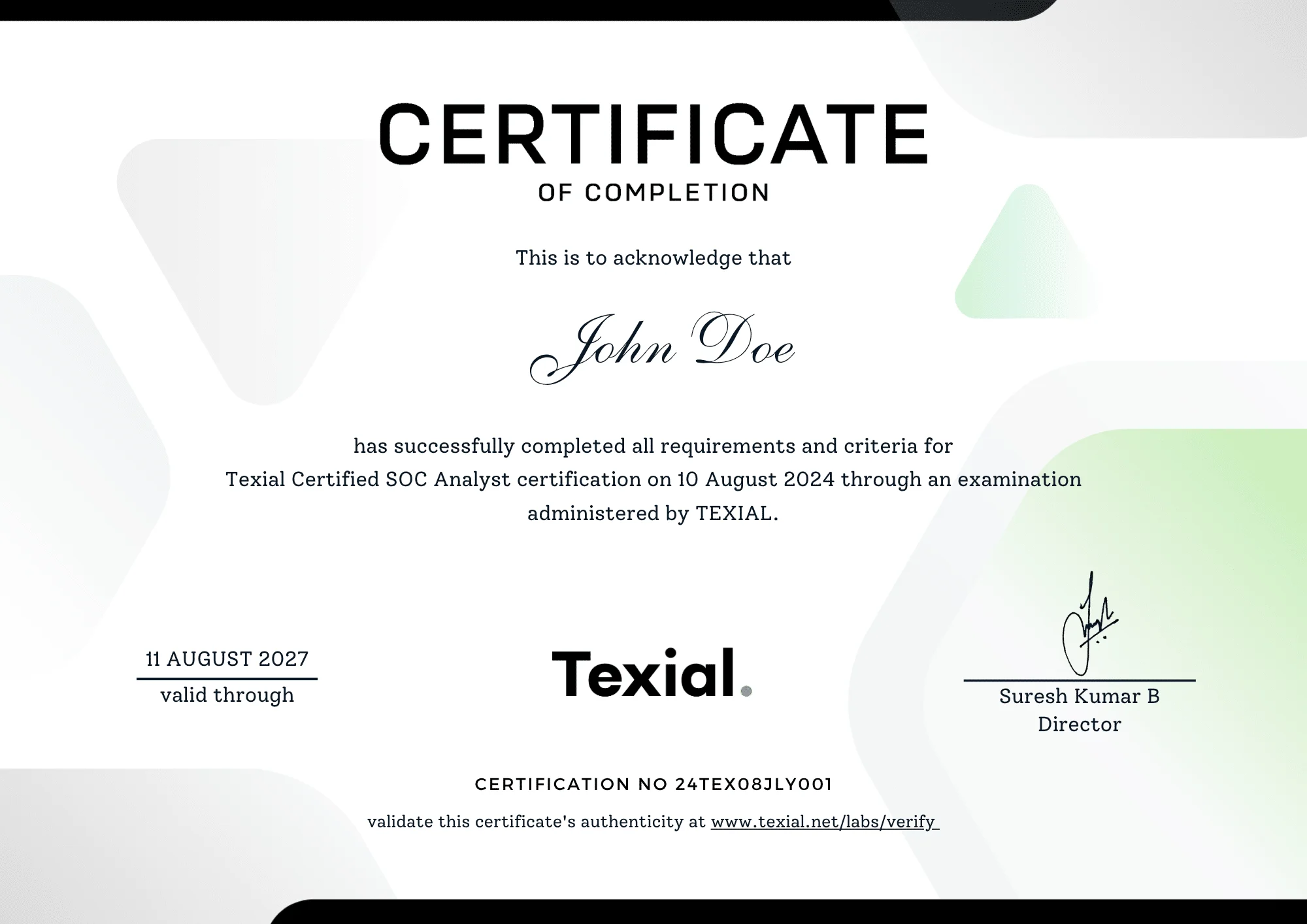
The Certified SOC Analyst (CSA v2) is a vital training program for an information security professional. The CSA SOC Analyst Course is the most comprehensive SOC Analyst Training program in the world.
- Globally Recognized NICE 2.0 SOC Credential
- Official EC-Council Accredited Courseware & iLabs
- Proctored 100-Question CSA Certification Exam
- Recognized by Global MSSPs, Banks & Big 4 Advisories

Texial Certified SOC Analyst (TCSA)
The Texial Certified SOC Analyst program is designed to prepare students with the right balance of theory and practice required to excel in Security Operations Centers (SOC). This cyber security course covers all the advanced SIEM, threat-hunting, and incident-response concepts.
- 4-Hour Practical SIEM & Incident Triage Exam
- Live Attack Detection Across Windows, Linux & Cloud Logs
- SOAR Playbook & Network PCAP Investigation Mastery cybersecurity experts
- Verifiable Credential for L1/L2 SOC Technical Panels
600+ SOC Analyst Tools Covered


Why Defend With Us
How Texial Builds Job-Ready SOC Analysts
From writing your first SPL query to surviving a simulated ransomware outbreak, our active SOC mentors guide your technical growth.
Active SOC Mentors
Train under working Tier-3 SOC leads, SIEM engineers, and incident responders who share real-world war stories and triage shortcuts from enterprise security centers.
True Multi-SIEM Lab Exposure
Instead of learning just one tool on slides, you practice log ingestion, parsing, and dashboarding across Splunk, Microsoft Sentinel, QRadar, and Elastic Security.
Daily Query & Lab Debugging
Stuck on a regular expression, KQL join, or Sysmon config? Get real-time screen-share troubleshooting at the end of every class and inside our technical forum.
Playbook & Ticket Reviews
Mentors personally grade your SIEM correlation rules, PCAP analysis timelines, and incident escalation tickets to ensure they meet enterprise SOC standards
Live Red vs. Blue Range Drills
Defend simulated corporate networks against live Red Team attacks—watching your SIEM alerts fire in real time as you isolate hosts and block C2 traffic.
Scenario-Based Mock Interviews
Practice answering the exact L1/L2 technical interview scenarios asked by MSSPs (Windows Event IDs, phishing triage steps, brute-force vs. password spray).
Reserve Batch Seat / Request Demo
Seat Inquiry Registered
Your batch details have been routed to the Texial Admissions Desk. Our counselor will reach out shortly, or you can open WhatsApp below.
Ethical Hacking (CEH v13 AI) — Upcoming Batches
Times shown in your local timezoneSOC Analyst Dual Certification Tuition: ₹45,000
Step 01
Register Your Inquiry or Book a Free Live SIEM Demo
Step 02
1-on-1 SecOps Career Mapping & Batch Timing Selection
Step 03
Instant Cloud SIEM Range & LMS Account Activation
Accelerate Your Blue Team Career
Start your Ethical hacking journey today and secure your future in tech by gaining in-demand skills, hands-on experience, and industry-recognized certifications that prepare you to defend against modern digital threats and excel in a fast-growing career field.
What Your Enrollment Includes
- 60 Hours of live instructor-led SOC & SIEM training + 6-month recorded LMS
- 24/7 browser access to multi-subnet Cloud SIEM & Threat Hunting labs
- ATS resume engineering, mock SOC panel interviews & placement drives
Dedicated SOC Career & Placement Cell
SecOps Role Mapping
Our advisors evaluate your background (fresher, NOC, sysadmin, or IT support) to target the right L1/L2 SOC Analyst, MDR Analyst, or SIEM Engineer openings.
ATS Resume & LinkedIn Branding
We showcase your CSA & TCSA certifications, MITRE ATT&CK detection matrices, SPL/KQL query projects, and SOAR playbooks so recruiters notice your profile first.
Capstone SOC Internships
Work on simulated 24/7 alert queues, investigate multi-stage intrusion logs, and compile professional incident closure reports for your portfolio.
Direct MSSP & Enterprise Hiring Drives
Interview with our network of 25+ recruitment partners—including ZeroFox, KPMG, EY, PwC, Cognizant, Capgemini, Atos, Bosch, Standard Chartered, and QSEAP.
Our Placement Partners
Our Student Reviews

Vivek Gaonkar
Placed at QSEAP
Texial is a great place for beginners to know about cyber security, Had an awesome learning experience here. The Training and coaching staff are friendly and always there to clear our doubts.

Sahana S
Placed at Zerofox
The place where I gained confidence and knowledge in the field of cyber security. Trustworthy environment to get certified. I hope to see few more certifications.

Nikhil Vithal Ghorpade
Placed at Zerofox
The training was good. The trainers were helpful and friendly throughout the course. The learning experience was good, trainers made sure every concept was clearly understood.

Abhay RS
Placed at Zerofox
A very professional and great teaching with good practicals . And a very good choice to learn ethical hacking in Texial Cyber security even if you are from any stream . Good supportive teaching staffs for betterment of skills. Can have very good knowledge of basics of ethical hacking and there is no restrictions to learn. Happy and satisfied learning in Texial Cyber security

Shreyas N
Placed at QSEAP
I was lucky enough to get a highly supportive recruiter, helped me in identifying the right opportunities based on my background, briefed in detail about the interview procedures which made the whole process so smooth, also following up in a timely manner helped me with all the updates. Thanks to Team Texial, I was able to get a great offer. From my experience, I’d strongly recommend you to try and get certification from Texial Cyber Security .

Abhishek K K
Placed at Zerofox
Institution is very good, trainers are friendly. The teaching is fast and they also clear all the doubts. They support you until you get a job. Nice institution for freshers to learn about cyber security and Ethical hacking.

Viksha
Placed at KPMG
Good experience and great training center for cyber security. Can learn from scratch and delighted to score 124/125 in CEH v13 AI. Excellent and Happy learning in Texial Cyber security
Vivek Gaonkar
Placed at QSEAP
Texial is a great place for beginners to know about cyber security, Had an awesome learning experience here. The Training and coaching staff are friendly and always there to clear our doubts.
Sahana S
Placed at Zerofox
The place where I gained confidence and knowledge in the field of cyber security. Trustworthy environment to get certified. I hope to see few more certifications.
Nikhil Vithal Ghorpade
Placed at Zerofox
The training was good. The trainers were helpful and friendly throughout the course. The learning experience was good, trainers made sure every concept was clearly understood.
Abhay RS
Placed at Zerofox
A very professional and great teaching with good practicals . And a very good choice to learn ethical hacking in Texial Cyber security even if you are from any stream . Good supportive teaching staffs for betterment of skills. Can have very good knowledge of basics of ethical hacking and there is no restrictions to learn. Happy and satisfied learning in Texial Cyber security
Shreyas N
Placed at QSEAP
I was lucky enough to get a highly supportive recruiter, helped me in identifying the right opportunities based on my background, briefed in detail about the interview procedures which made the whole process so smooth, also following up in a timely manner helped me with all the updates. Thanks to Team Texial, I was able to get a great offer. From my experience, I’d strongly recommend you to try and get certification from Texial Cyber Security .
Abhishek K K
Placed at Zerofox
Institution is very good, trainers are friendly. The teaching is fast and they also clear all the doubts. They support you until you get a job. Nice institution for freshers to learn about cyber security and Ethical hacking.
Viksha
Placed at KPMG
Good experience and great training center for cyber security. Can learn from scratch and delighted to score 124/125 in CEH v13 AI. Excellent and Happy learning in Texial Cyber security
Our Advisory
Ethical Hacking Course in Dehradun, Uttarakhand Advisory



SOC Analyst Course & Blue Team Training — Frequently Asked Questions (FAQs)
What is a SOC Analyst Course, and what does a Security Operations Center (SOC) Analyst do?
SOC Analyst Course is a specialized defensive cybersecurity (Blue Team) training program that prepares you to monitor, detect, investigate, and respond to cyber threats inside an enterprise Security Operations Center (SOC). As a SOC Analyst, you serve as an organization’s 24/7 front-line cyber defender. Your daily responsibilities include monitoring SIEM (Security Information and Event Management) dashboards, triaging real-time security alerts, filtering out false positives, analyzing endpoint (EDR/XDR) and network packet (PCAP) telemetry, correlating Indicators of Compromise (IoCs) against threat intelligence feeds, containing active malware or phishing breaches, and authoring incident closure reports.
What is the difference between Tier 1 (L1), Tier 2 (L2), and Tier 3 (L3) SOC Analysts?
Enterprise Security Operations Centers organize defenders into three operational tiers based on technical depth:
- Tier 1 (L1) SOC Analyst — Alert Triage Specialist: Monitors the 24/7 SIEM alert queue (Splunk, Microsoft Sentinel, QRadar), validates incoming alerts against standard operating procedures (SOPs), suppresses false positives, performs initial IOC enrichment, and opens incident tickets for confirmed threats.
- Tier 2 (L2) SOC Analyst — Incident Responder: Receives escalated tickets from L1 analysts, conducts deep-dive root-cause investigations across endpoint memory, Windows/Linux logs, and network traffic, executes host containment and eradication playbooks, and coordinates with system administrators to remediate breaches.
- Tier 3 (L3) SOC Analyst — Threat Hunter & Detection Engineer: Proactively hunts for stealthy Advanced Persistent Threats (APTs) and zero-day intrusions that evade existing alerts, reverse-engineers malware, and writes custom SPL, KQL, SIGMA, and YARA detection rules to strengthen SOC visibility. Texial’s 60-hour program trains you across L1, L2, and foundational L3 workflows.
What is Blue Team cybersecurity training, and how does a SOC Analyst course differ from an Ethical Hacking (Red Team) course?
In cybersecurity, Red Team (Ethical Hacking / Penetration Testing) focuses on offensive security—simulating cyberattacks to find and exploit vulnerabilities before criminals do. Blue Team (SOC Analyst / Defensive Security) focuses on defensive security—building resilient monitoring architectures, analyzing logs, detecting intrusions in real time, and responding to active cyberattacks. While Red Teamers use offensive tools like Metasploit and Burp Suite to break into systems, Blue Team SOC Analysts use defensive platforms like Splunk, Microsoft Sentinel, IBM QRadar, Wireshark, Velociraptor, and SOAR to catch the attacker, block lateral movement, and recover compromised assets. Because every enterprise with a digital footprint requires 24/7 monitoring, Blue Team SOC roles account for the largest volume of entry-to-mid-level cybersecurity job openings worldwide.
Which SIEM, EDR/XDR, SOAR, and Threat Intelligence tools will I master in this course?
Over 70% of your 60-hour training takes place inside Texial’s 24/7 browser-accessible Cloud Cyber Range, where you gain hands-on command over industry-standard Blue Team utilities:
SIEM & Log Management Platforms: Splunk Enterprise (SPL), Microsoft Sentinel (KQL), Elastic Security / ELK Stack (Elasticsearch, Logstash, Kibana), IBM QRadar, Wazuh, and ManageEngine Log360.
Endpoint Detection (EDR/XDR) & Digital Forensics: Velociraptor, Windows Event Viewer, Sysmon, PowerShell Threat Hunting, Autopsy, and Volatility memory analysis.
Network Forensics & IDS/IPS: Wireshark, Tcpdump, Snort, Suricata, and Zeek.
Threat Intelligence (CTI) & Detection Engineering: VirusTotal, Cisco Talos, AlienVault OTX, Abuse.ch, IPVoid, MISP, SIGMA rules, and YARA malware signatures.
Incident Response & SOAR Automation: TheHive, Cortex, and automated SOAR playbook workflows.
Do I need prior coding, programming, or IT work experience to become a SOC Analyst?
No. You do not need a software engineering background or prior IT work experience to enroll in Texial’s SOC Analyst Course. Unlike software development, SOC operations rely on analytical thinking, network protocol logic, operating system fundamentals, and security query languages rather than building applications from scratch. Our curriculum starts from Module 1 with OSI and TCP/IP networking, DNS, the 3-way handshake, Windows and Linux OS internals, and firewall/IDS concepts before teaching you step-by-step how to write SIEM search queries (SPL and KQL) and read PowerShell or Bash logs. Furthermore, completing official EC-Council accredited training with Texial waives the 1-year work experience prerequisite for the EC-Council CSA exam.
Can a fresher, college student (B.E./B.Tech, BCA, MCA, B.Sc.), or non-IT professional land a SOC Analyst job?
Yes. Tier 1 (L1) SOC Analyst is the #1 entry point into the global cybersecurity industry for fresh college graduates and career switchers. Because Managed Security Service Providers (MSSPs), Global Capability Centers (GCCs), banking institutions, and Big 4 consultancies operate 24/7/365 security operations centers, they continuously recruit certified freshers and professionals transitioning from NOC (Network Operations), Desktop/Tech Support, System Administration, QA Testing, and non-IT backgrounds who can demonstrate hands-on SIEM triage and MITRE ATT&CK knowledge during technical interviews.
What is the difference between the EC-Council Certified SOC Analyst (CSA) and Texial Certified SOC Analyst (TCSA) certifications?
Our dual-credential track combines global vendor recognition with deep practitioner proof:
EC-Council Certified SOC Analyst (CSA): An internationally recognized vendor certification mapped 100% to the NICE Cybersecurity Workforce Framework 2.0. It is widely used by enterprise HR departments and ATS resume filters across the US, UK, UAE, and India to shortlist candidates for L1 and L2 SOC roles.
Texial Certified SOC Analyst (TCSA): Our hands-on practitioner credential engineered by active SOC leads. While standard multiple-choice vendor exams test theory, the TCSA track trains and tests you inside a live simulated cyber range across 10 modules—including SOAR playbook engineering, network PCAP forensics, email phishing header analysis, and regulatory compliance (CERT-In, GDPR, PCI-DSS v4.0, ISO 27001).
What are the career opportunities available for a Certified Ethical Hacking Graduate?
Because you enroll in a dual-certification program, two separate assessments validate your theoretical and practical mastery:
EC-Council CSA Exam (Exam Code 312-39): A 3-hour online proctored examination consisting of 100 multiple-choice questions testing security operations, log analysis, SIEM correlation, threat intelligence, and incident response (passing score: 70%). The credential is valid for 3 years under the EC-Council Continuing Education (ECE) policy.
Texial Certified SOC Analyst (TCSA) Exam: A 4-hour hands-on practical examination conducted inside Texial’s Cloud Cyber Range, where you investigate simulated security incidents, extract IoCs from logs and PCAPs, and submit an executive incident closure report. The TCSA credential is valid for 3 years.
What is the examination format, duration, and validity for the EC-Council CSA and Texial TCSA credentials?
Because you enroll in a dual-certification program, two separate assessments validate your theoretical and practical mastery:
EC-Council CSA Exam (Exam Code 312-39): A 3-hour online proctored examination consisting of 100 multiple-choice questions testing security operations, log analysis, SIEM correlation, threat intelligence, and incident response (passing score: 70%). The credential is valid for 3 years under the EC-Council Continuing Education (ECE) policy.
Texial Certified SOC Analyst (TCSA) Exam: A 4-hour hands-on practical examination conducted inside Texial’s Cloud Cyber Range, where you investigate simulated security incidents, extract IoCs from logs and PCAPs, and submit an executive incident closure report. The TCSA credential is valid for 3 years.
What is the fee structure and duration of Texial’s SOC Analyst Course?
The complete SOC Analyst training program runs for 60 hours (approximately 6 to 8 weeks via regular weekday batches or 8 to 10 weeks via weekend batches). We offer two transparent enrollment options:
Option 1 — Texial Certified SOC Analyst (TCSA) + SOC Training Track (₹30,000): Includes all 60 hours of live instructor-led training, 24/7 Cloud Cyber Range access, hands-on labs across all CSA and TCSA modules, and the TCSA practical exam and certification.
Option 2 — All-Inclusive Dual Certification Track: EC-Council CSA + TCSA (₹45,000): Includes everything in Option 1 plus your official EC-Council CSA exam voucher, 6 months of official EC-Council e-courseware and iLabs access, Blue Team CTF simulations, and 100% placement support.
How does SIEM log correlation work, and will I learn to write custom SPL, KQL, SIGMA, and YARA detection rules?
Yes. A core differentiator of Texial’s curriculum is Detection Engineering. Instead of just clicking pre-built alerts, you will learn how raw logs are generated when an attack occurs (such as Windows Event ID `4625` for failed logins followed by `4624` Type 10 for RDP lateral movement or `4688` for suspicious PowerShell execution). You will ingest these logs into Splunk and Elastic Security (ELK), write custom SPL (Search Processing Language) and KQL (Kusto Query Language) queries to correlate multi-stage attacks, author vendor-agnostic SIGMA rules for SIEM alerts, and write YARA signatures to hunt malware binaries across endpoints.
How are the MITRE ATT&CK, MITRE D3FEND, and NIST CSF 2.0 frameworks integrated into the training?
Modern SOC interviews heavily test your ability to map attacks to industry frameworks. Throughout our lab exercises, you will use the MITRE ATT&CK Matrix to classify adversary Tactics, Techniques, and Procedures (TTPs)—from Initial Access and Execution to Credential Access (e.g., `T1003` OS Credential Dumping), Lateral Movement, and Command & Control (C2). You will then use MITRE D3FEND and the NIST Cybersecurity Framework (CSF 2.0 — Govern, Identify, Protect, Detect, Respond, Recover) to design defensive countermeasures, map SIEM detection coverage, and structure your incident response playbooks.
How is Artificial Intelligence (AI) and SOAR automation changing SOC operations, and is it covered in the syllabus?
Modern Security Operations Centers are rapidly evolving from manual log review to AI-Driven SOC and SOAR (Security Orchestration, Automation, and Response) architectures. In this course, you will learn how AI-powered SIEM analytics and UEBA (User and Entity Behavior Analytics) detect subtle insider threats and zero-day anomalies, how AI Security Copilots accelerate alert summarization and KQL/SPL query generation, and how to build automated SOAR playbooks and runbooks that automatically enrich suspicious IPs/hashes via VirusTotal, isolate infected endpoints, and block malicious domains on perimeter firewalls in seconds.
What is the average salary of a Certified SOC Analyst in India, the US, the UK, and the UAE?
Because 24/7 threat monitoring is mandatory for banking, healthcare, SaaS, and government enterprises, Certified SOC Analysts command highly competitive compensation packages:
In India: Entry-level L1 SOC Analysts earn between ₹5.0 LPA and ₹8.5 LPA, mid-level L2 SOC Analysts and SIEM Engineers (2–5 years of experience) earn ₹10.0 LPA to ₹18.0 LPA, and Senior L3 Threat Hunters and SOC Managers earn ₹20.0 LPA to ₹32.0+ LPA.
In the United States: Entry-to-mid-level SOC Analysts earn between $85,000 and 125,000USDperyear,withSeniorDetectionEngineersexceeding150,000+ USD.
In the UK & Europe: Compensation ranges from £45,000 to £85,000+ GBP (€55,000 – €95,000+ EUR).
In the UAE & Middle East (Dubai / Riyadh): Tax-free salaries for SOC Analysts range from AED 144,000 to AED 280,000+ per year.
How are the hands-on SOC Cyber Range labs conducted, and what laptop specifications do I need?
All practical exercises—including live attack simulations, SIEM log ingestion, packet analysis, and endpoint threat hunting—are hosted inside Texial’s 24/7 browser-accessible Cloud Cyber Range. Because our cloud servers handle the heavy virtualization of multi-subnet enterprise networks, Splunk/ELK clusters, and target machines, you do not need an expensive workstation. Any Windows, macOS, or Linux laptop with 8 GB RAM (16 GB recommended if running local VMs), an Intel i5 / AMD Ryzen 5 / Apple M-series processor, and a stable broadband internet connection works seamlessly.
Are live online, evening, and weekend batches available for working IT, NOC, and Tech Support professionals?
Yes. We offer In-Person Classroom Batches, 100% Live Interactive Virtual Classrooms, and a Blended Hybrid Track. Every online session is conducted live by an accredited instructor (never pre-recorded video dumps), allowing you to share your screen and troubleshoot SIEM queries in real time. We run dedicated weekday morning batches, weekday evening batches, and Saturday–Sunday weekend cohorts so working professionals and college students can upskill without disrupting their work or academic schedules—backed by 6 months of HD recorded LMS access for revision.
How does Texial’s SOC internship and 100% placement assistance program work?
Our Dedicated Cybersecurity Placement Cell supports you from day one until you sign your offer letter. You receive 1-on-1 career counseling, ATS-optimized resume and LinkedIn profile engineering, a verifiable portfolio of SIEM use-case rules and incident closure reports, structured SOC internship opportunities, and intensive mock technical panel interviews (covering common L1/L2 scenario questions like phishing triage, ransomware containment, and Windows Event IDs). You then interview directly through our placement drives with 25+ hiring partners, including ZeroFox, KPMG, EY, PwC, Cognizant, Capgemini, Atos, Bosch, Honeywell, Standard Chartered, Bank of America, and QSEAP.
Where are Texial’s physical training centers located, and how can I book a free live SOC demo class?
Texial operates physical offline training campuses in Bangalore (Jayanagar), Hyderabad (Ameerpet), Pune (Shivajinagar), Kolkata (Salt Lake Sector V), Coimbatore (R.S. Puram), and Dubai, alongside live interactive online cohorts accessible from any city worldwide. You can book a free 1-on-1 live SOC lab demo and career counseling session by clicking “Book a Demo” on this page, selecting an open cohort in the Upcoming Batches schedule above, or calling/WhatsApping our Admissions Desk at +91 98866 55699.
Build an Unbeatable Blue Team Career
EC-Council Accredited Certified SOC Analyst (CSA) & SIEM Training
As enterprise cloud infrastructures expand, hybrid workforces grow, and automated threat actors deploy lightning-fast exploits, perimeter firewalls alone are no longer enough. Organizations across banking, finance, healthcare, SaaS, and retail now demand 24/7 Security Operations Centers (SOCs) to maintain continuous visibility—making certified Blue Team defenders the absolute cornerstone of modern enterprise defense.
The EC-Council Certified SOC Analyst (CSA) credential is the global gold standard for defensive security professionals, trusted by Fortune 500 security leaders, government intelligence units, and premier managed security service providers (MSSPs). By combining official EC-Council CSA training with Texial’s hands-on Texial Certified SOC Analyst (TCSA) curriculum, you don’t just study log theory—you gain live operational command over enterprise SIEM platforms, EDR/XDR telemetry, threat intelligence feeds, and automated SOAR incident response.
As an official EC-Council Accredited Training Partner, Texial bridges the gap between foundational networking and high-speed Security Operations Center execution. Whether you choose our immersive physical classrooms or live virtual instructor-led cohorts, our active SOC mentors and dedicated placement cell guide you from your first SIEM alert triage to your next high-paying Blue Team job offer.
| SOC & Blue Team Job Role | Experience | India Compensation (INR) | Global Compensation (USD) |
|---|---|---|---|
| Tier 1 (L1) SOC Analyst / Junior Cyber Security Analyst | 0 – 2 Years | ₹5.5 LPA – ₹8.5 LPA | $85,000/yr |
| Tier 2 (L2) SOC Analyst / Incident Response (CSIRT) Specialist | 2 – 5 Years | ₹10.0 LPA – ₹16.5 LPA | $118,000/yr |
| Senior SIEM Engineer / Threat Hunter & Detection Engineer (L3) | 4 – 7 Years | ₹17.0 LPA – ₹24.0 LPA | $145,000/yr |
| Principal SOC Architect / SecOps Manager & MDR Lead | 7+ Years | ₹25.0 LPA – ₹35.0+ LPA | $175,000+/yr |
1. Inside Our 24/7 Cloud SIEM Cyber Range & Blue Team Tool Stack
Texial’s 24/7 browser-accessible Cloud Cyber Range replicates a live enterprise Security Operations Center. Participants onboard and normalize log streams from Windows Active Directory, Linux servers, IIS/Apache web servers, and perimeter firewalls into Splunk Enterprise, Microsoft Sentinel, IBM QRadar, Wazuh, and Elastic Security (ELK Stack). You will write custom SPL and KQL correlation queries, deploy vendor-agnostic SIGMA rules, hunt endpoint persistence using Velociraptor and YARA signatures, inspect malicious PCAPs in Wireshark, and enrich Indicators of Compromise (IoCs) via VirusTotal, Cisco Talos, and AlienVault OTX.
2. Enterprise Regulatory Compliance, SIEM Auditing & SOC Maturity
Modern SOC operations are tightly governed by global and national compliance mandates. Beyond technical alert triage, our dual-track curriculum trains you to align log retention, incident escalation, and audit reporting with NIST CSF 2.0, ISO/IEC 27001, PCI-DSS v4.0, SOC 2, GDPR, HIPAA, and CERT-In (6-hour incident reporting mandate). Through the Texial Certified SOC Analyst (TCSA) track, you learn to track core SOC KPIs—including Mean Time to Detect (MTTD) and Mean Time to Respond (MTTR)—and generate audit-ready compliance dashboards for CISOs and external assessors.
3. SOC Analyst Career Tracks (Tier 1, Tier 2, Tier 3) & Salary Progression
Graduating with dual EC-Council CSA and Texial TCSA credentials opens a clear, rapid career trajectory across global MSSPs, banking GCCs, and Big 4 advisories. You can enter the industry as a Tier 1 (L1) Alert Analyst (₹5.5–8.5 LPA in India / $85k+ globally), advance within 18–24 months to a Tier 2 (L2) Incident Responder or SIEM Engineer (₹10–16.5 LPA / $118k+), and scale into senior roles as a Tier 3 (L3) Threat Hunter, Detection Engineer, or Purple Team Specialist commanding ₹17–35+ LPA ($145k–$175k+ globally).
4. Flexible Live Cohort Schedules, 6-Month Recorded LMS & First-Attempt Exam Prep
Whether you attend our physical classroom bootcamps or join our 100% live interactive online cohorts, every session is led in real time by an accredited practitioner. We run weekday morning, weekday evening, and weekend batches to fit university and shift-work schedules. All classes are backed by 6 months of HD recorded LMS access, full-length EC-Council CSA (312-39) mock exams, and guided TCSA cyber range assessments so you pass both certification exams on your first attempt.
